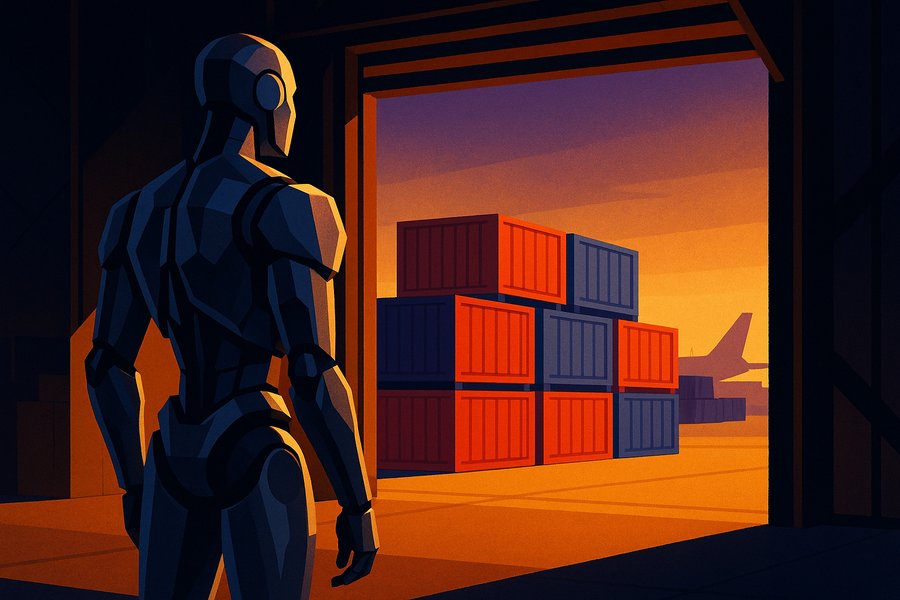
A humanoid robot delayed a Southwest Airlines flight out of Oakland last week. Its name is Bebop, it weighs about 32 kilograms, and it had been booked as a passenger for a work trip to San Diego. The hold-up, it turned out, was about batteries: Bebop's lithium power pack exceeded the airline's maximum permitted size and had to be confiscated before the aircraft could push back. The robot entertained the other passengers while the matter was sorted out. Its team is now overnighting replacement batteries to Chicago for the next engagement.
It is a small, faintly absurd story. It is also a useful marker for where physical AI now sits. The delays are no longer about whether robots can walk, lift, or respond to their environment. The delays are about lithium battery regulations. That is a different kind of problem entirely.
This week brought several more data points showing how quickly that transition is happening. Japan Airlines has announced a two-year pilot project deploying humanoid robots at Haneda Airport in Tokyo, starting with cargo handling and expanding into cabin cleaning and runway equipment operation. The driver is not technology enthusiasm but a grimly practical labour shortage: Japan's population is ageing rapidly while international tourism is surging, and airlines cannot find enough people willing to do physically demanding airport work. The robots were developed with GMO AI and Robotics. Their first jobs are the heaviest and least desirable ones, which is where human labour has been declining fastest.
In China, the deployment story looks different but points in the same direction. A Zhejiang-based company called RobotPlusPlus has put humanoid robots to work on the vertical steel walls of chemical tanks, where they weld, scan for flaws, and remove rust. These are jobs that previously required workers to hang in mid-air for hours, exposed to fumes, wind, and heat. "Now, an operator in a cool control room, wearing VR glasses, simply moves the wrist, and the robot on the wall mirrors the action with millisecond-level response," the company's founder told Xinhua. The robot weighs 90 kilograms, uses magnetic adhesion to stay on vertical surfaces, and can swap end-effectors to switch between tasks. It is not a prototype. It is on the wall.
The corporate layer is moving to match. Meta this week confirmed its acquisition of Assured Robot Intelligence, a startup focused on training AI systems to understand, predict, and adapt to human behaviour in complex physical environments. The team, including co-founders from leading robotics research groups, is joining Meta's Superintelligence Labs. Meta is not yet building a consumer robot, but it is acquiring the foundational research capability to do so, positioning itself alongside Amazon, which acquired humanoid robot maker Fauna in March, and Tesla, which Elon Musk has long argued could become the world's most valuable company on the back of humanoid robot production.
What unites all of these developments is not any single technology breakthrough. It is the shift from demonstration to deployment. The robots at Haneda are not performing for a press audience; they are moving cargo containers on a schedule. The machines on the chemical plant wall in Zhejiang are doing work that would otherwise require safety harnesses and risk assessments. The question the industry has been asking for years, whether physical AI can do anything genuinely useful, is being answered not by researchers but by logistics managers and airport operators with labour shortages to fill.
None of this means humanoid robots are everywhere tomorrow. The gap between a controlled industrial application and a robot that can navigate the full unpredictability of a human workplace remains significant. But the gap is closing, and it is closing in the places where it matters most: environments that are dangerous, repetitive, or simply short of willing workers. What the Bebop incident at Oakland airport captures, inadvertently, is the texture of a transition already underway. The robot is on the plane. The question now is whether the batteries are the right size.