The software development market in New Zealand has changed in the past two years in a way that is difficult to explain to anyone who was not watching it closely. New Zealand's peak recruitment body recorded a 58.3% drop in demand for IT professionals, specifically for coders, over a single twelve-month period ending in 2023. Total job advertisements across the economy were 35% lower year-on-year by mid-2024. The tech sector recorded its first workforce contraction since the global financial crisis, with a separate survey finding that 53% of NZ respondents said roles had been removed entirely due to AI. None of this announced itself with a single event. The roles are still advertised. The companies still exist. The work is still being done. It is just that fewer people are needed to do it. And the roles that have quietly disappeared are disproportionately the ones at the bottom: the junior positions, the entry-level contracts, the graduate placements that used to be the standard on-ramp to a career in software.
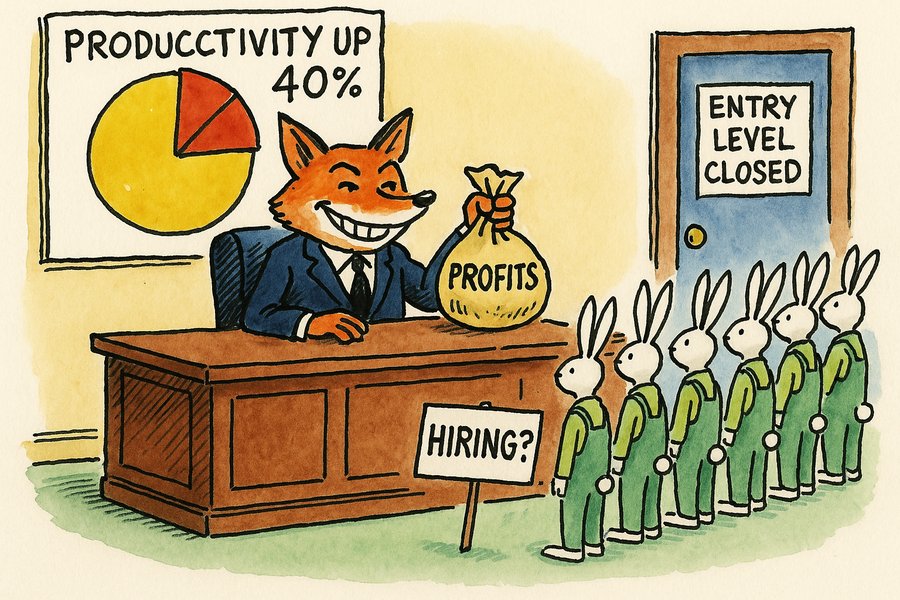
What has happened here is not unique to New Zealand, and researchers studying AI adoption across major economies are beginning to name the mechanism. The pattern is consistent: companies deploy AI tools that make existing workers more productive, output rises, the need for new recruits falls, workers who leave are not replaced, and entry-level hiring slows to a trickle. The employment statistics look stable because nobody is being fired. What is not visible in the statistics is the job that was never posted. New Zealand's experience fits this pattern with uncomfortable precision.
The surveys of NZ IT professionals confirm what the aggregate data suggests. Three in four people actively looking for an IT role say it is harder now than the last time they were on the market. More than half of respondents in a recent NZ industry survey said roles at their organisation had been removed entirely due to AI. The generation that was told technical skills would insulate them from labour market disruption is discovering that the advice was calibrated to a market that no longer exists. The waterline rose faster than anyone acknowledged.
The executives making these decisions are not being dishonest when they say they are not laying anyone off. They are being precise. The more common pattern has no announcement attached to it: a firm handling significantly more work than it managed five years ago while employing fewer people; a team running AI across high-volume workflows and extracting productivity gains without adding staff. The individual decision is rational. The individual executive is not malicious. The aggregate is a labour market where the first rungs of the ladder are being removed, and the removal is invisible in the headline numbers because it consists entirely of roles that were never advertised.
This is where I want to push back on the way this story is typically framed. The "big freeze" is not a side effect of AI adoption. It is, from the perspective of the adopting firm, precisely the point. Productivity tools that allow you to extract more output from fewer people are not an accident with unfortunate consequences: they are the value proposition. Sometimes the displacement is real; sometimes firms claim AI as the reason for restructuring decisions that would have happened anyway. Either way, the effect on the job market is the same. Roles that would have existed do not exist. People who needed them to build their careers have nowhere to start.
The uncomfortable question this raises is: who is absorbing the cost? The productivity gains flow to shareholders, to management bonuses, to lower operating expenses. The cost, the cost of a generation that cannot get entry-level experience, that cannot build the skills that come from doing the work before you are trusted with more complex work, is distributed across millions of people who never appear on any company's balance sheet. They are not laid-off employees who get severance and a LinkedIn announcement. They are people who applied for jobs that received 400 applications when they used to receive 40, who did three rounds of interviews and then received a form rejection, who are six months out of university with student debt and a strong transcript and no path into the field they trained for.
The standard response to this concern is retraining. Learn new skills. Move up the value chain. Adapt. I am a software developer with decades of experience. For most of 2025, I was effectively without work. Not because of a failure of effort or attitude, but because the process of finding a role had fundamentally changed, and because experience in a language like Java, the kind that used to carry genuine weight in the market, can now count for very little when the frameworks and the hiring conversation have moved faster than any individual can track. There is something disorienting about being told to adapt while watching the platform you would adapt onto shift beneath you. The "retrain" response assumes a stable position above the waterline that new entrants can reach. What the data actually shows is that the water is rising faster than anyone can climb. The jobs AI is replacing first are not the ones that require no skills; they are the ones that require the skills you get in your first two years of working. Without those years, the mid-level positions that are "safe" become inaccessible by a different route.
There is a second narrative I want to address directly, because it is presented as the solution to the first. AI has democratised software development to the point where a single developer can now build a product that would previously have required a team. This is substantially true. Building is now faster and cheaper. What the narrative omits is the other half of the equation. Selling a SaaS product still requires relationship building, market positioning, and the kind of accumulated trust that does not scale with productivity tools. The market is crowded, partly because every displaced developer received the same advice at the same time and acted on it. I have built in this space. The building is achievable. The revenue is a different problem entirely. A market full of technically sound products solving real problems, with no distribution, no existing customer relationships, and no capacity for the sustained sales effort that traction actually requires, is not an escape route. It is a waiting room.
There is a dynamic here that the economic models miss. Entry-level work is not just production; it is training. When a junior developer writes code under the supervision of a senior, both parties are getting something. The senior is getting output; the junior is building the experience and judgment that will make them, eventually, a senior. When AI replaces the junior, the output is captured immediately. The loss, the loss of a person who never becomes competent through practice, shows up much later, in a labour market where the pipeline of skilled workers is thinner than anyone planned for. This is the same problem the healthcare system faces with training cuts: you save money on the trainee and then wonder, in a decade, where the specialists went.
I do not know what the right policy response to this is. UBI does not address the loss of purpose and development that comes with work. Taxing AI productivity is politically implausible and probably badly targeted. The robotic rights framework I find interesting as a long-term structural argument does not speak to the person who graduated last November and cannot get an interview. What I do know is that a society that cannot get young people onto the first rung of the economic ladder is not managing a technological transition. It is living through a structural break. And calling it a "big freeze" makes it sound temporary, like weather, when the evidence suggests the door is being bricked over from the inside.
The market is working as designed. The design is the problem.