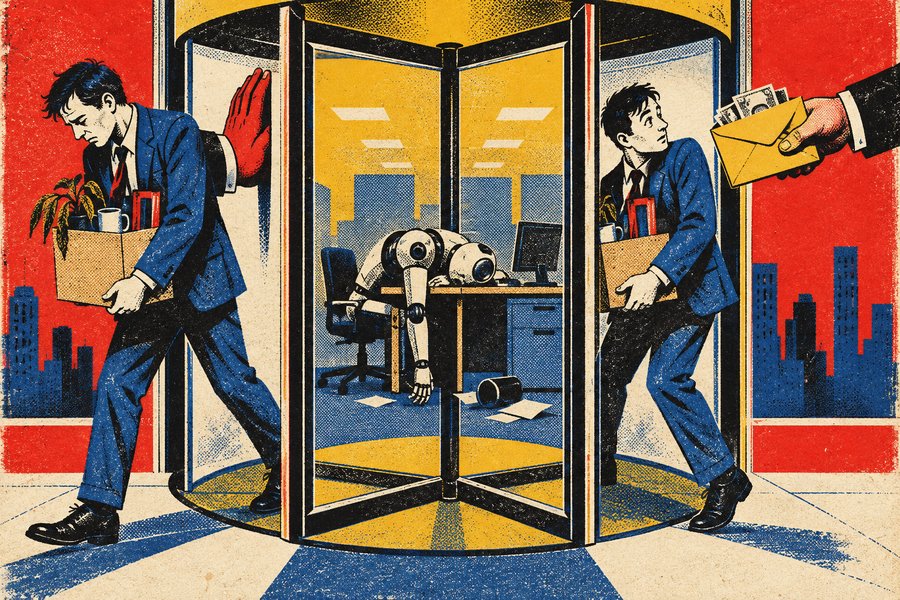
Sixteen percent of workers across the United States and the United Kingdom say they were replaced by artificial intelligence and later asked to return by the same employer, according to a survey of 2,036 employed adults commissioned by the talent-assessment firm SHL and conducted by Propeller Insights in June and July. The US figure was 19.1 percent and the UK 13 percent. SHL calls the pattern "AI rebounding," and says it describes companies that automate a role before they have gauged what their staff actually did, then rehire the same people once the gap becomes obvious. Among those asked back, 51 percent said they would want a substantial pay rise before returning, 42 percent wanted written job-security guarantees, and 40 percent wanted transparency about how AI would be used in their roles.
These are respondents' own accounts, not verified employment records, and that limits what they prove. A reported sequence does not establish that AI alone caused the original layoff, that the technology could not do the job, or that anyone returned at higher cost; SHL provides no financial comparison behind its claim that firms rehire "at a far greater cost." The survey also does not make clear whether the pay and security figures apply only to those who experienced rebounding or to a wider group. Lucy Beaumont, SHL's global senior vice-president of product and design, said AI "doesn't deliver" in these cases, a characterization the survey itself cannot confirm.
Named corporate examples point the same way. The Swedish buy-now-pay-later company Klarna began directly hiring human customer-service agents after leaning heavily on AI chatbots, with chief executive Sebastian Siemiatkowski acknowledging the firm had gone too far; a spokesperson said humans were needed for "complex, sensitive cases." Ford hired and promoted 350 experienced engineers in June after AI-powered quality tools underperformed, saying the technology mattered to quality gains but worked only "in tandem with deep technical expertise." A separate Robert Half survey found 32 percent of US hiring managers at firms that had cut roles because of AI later reinstated the same or similar positions, most citing institutional knowledge, relationship management or oversight that AI could not replace.
The reversals coexist with evidence that AI is reshaping hiring more than it is reversing it. Challenger, Gray & Christmas counted 121,401 announced job cuts citing AI through October, more than double the 54,836 for all of 2025. Yet a synthesis of three Morgan Stanley reports published between 6 and 9 November concluded that displacement is real but shows up chiefly as "headcount containment," slower hiring and revenue growth decoupled from headcount, rather than mass layoffs; the bank estimates AI has added no more than 15 basis points to the US unemployment rate. The share of S&P 500 firms citing direct AI workforce effects rose from about 14 percent to 22 percent over six months, with explicit cuts made to fund AI investment accounting for only around 3 percent of mentions.
The burden falls unevenly on the young. Stanford's Digital Economy Lab found employment among workers aged 22 to 25 in highly AI-exposed occupations running about 19 percent below where it would have been had it tracked less-exposed peers, a gap the researchers attribute mainly to slower hiring rather than more firings, and describe as descriptive rather than causal. SHL found younger workers more likely to report being rebounded, with 24 percent of those aged 18 to 24 saying they had been replaced and asked back. Taken together, the data sketch a labour market that is neither collapsing nor settled: firms are automating faster than they can judge what they are automating, and some are discovering, expensively, which human work they still need. What remains unverified is how often these reversals happen and whether rehired workers actually command the better terms the survey says they will seek.