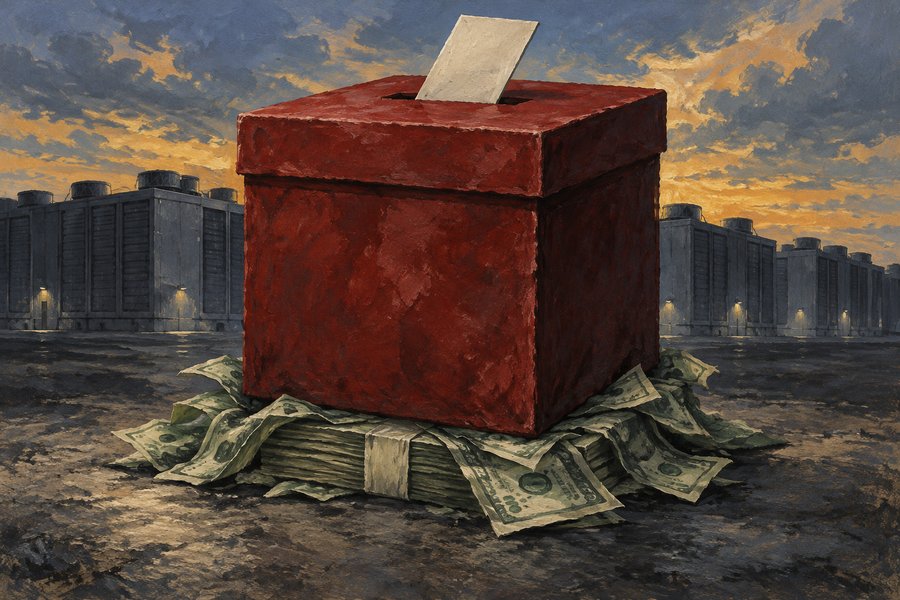
The AI industry's accelerationist wing spent more than $100 million to shape the 2026 US midterms and lost nearly every race it contested, as Democrats swept both chambers of Congress on November 3. An NBC exit poll found that 56% of voters called AI and data centers a "crucial or major factor" in their vote, and candidates who ran against data center expansion won in states including Ohio, Kansas and Iowa.
The scale of the industry's defeat was specific. Leading the Future, a pro-AI super PAC launched in August 2025 with more than $100 million, found its money had become a liability: one survey cited by Time reported that three-quarters of likely voters said they would be less likely to back a candidate who took an AI super PAC donation. Elon Musk was the cycle's biggest single donor at $446 million, roughly $168 million of it behind Ken Paxton in Texas; Paxton lost to James Talarico, who campaigned against "sweetheart tax deals" for Big Tech.
Data centers, not abstract fears about superintelligence, drove the result. Blue Rose Research found Americans would rather live near a prison, a methadone clinic or a nuclear plant than an AI data center, with higher energy bills, noise and water use the most salient concerns. Bans or moratoriums passed in counties from Edgewater, Florida to Bloomington, Illinois, and the mayors of Piqua, Ohio and Yukon, Oklahoma were recalled over past support for data center projects. The backlash crossed party lines: in Wisconsin, Republican Tom Tiffany attacked "Data Center David Crowley," yet Crowley tightened his stance on restrictions and won.
The financial unease is already visible in the market. Goldman Sachs and Apollo this week began selling portions of a roughly $40 billion chip financing deal for Elon Musk's SpaceX to outside investors, moving against a backdrop of retreat from the AI trade. Goldman has separately warned that 45% of planned US data center capacity could be affected by the siting pushback, and Microsoft declined a potential multibillion-dollar expansion of its computing deal with Nvidia-backed Nscale in Texas. Meta president Dina Powell McCormick told a Wall Street Journal conference that "building new data centers in the United States is going to be very difficult going forward."
What the vote does not guarantee is sweeping federal law. With Donald Trump holding the veto pen through January 2029 and the Senate filibuster intact, Democrats would need substantial Republican support to pass binding AI rules. The more likely near-term consequence is oversight: House Democratic leaders have already asked five frontier AI companies to report safety and misalignment incidents to Congress within 48 hours of detection, and Senator Maria Cantwell, positioned to chair the Commerce Committee, has floated enforceable NIST safety standards and pre-release audits. A separate wing is pushing further still, with Representative Yassamin Ansari and nine other Democrats introducing an "ASI Prohibition Act" to halt training above certain compute thresholds.
The ban on state AI regulation that Republicans had sought now looks far harder to enact, leaving California's SB-53 and laws in New York, Colorado, Texas and Illinois as the operative baseline. The industry is adjusting its language rather than its plans: Axios reports OpenAI intends to rebrand data centers as "AI compute campuses" and has announced a "Grid Protector Program" to cut power draw at peak hours, starting in Georgia. Blue Rose ranks AI 29th of 39 issues by importance, but its salience rose faster this year than any other. As the firm's research director put it, this was "the first cycle where AI showed up in the political discourse, and it's arguably the least important that it will ever be again."