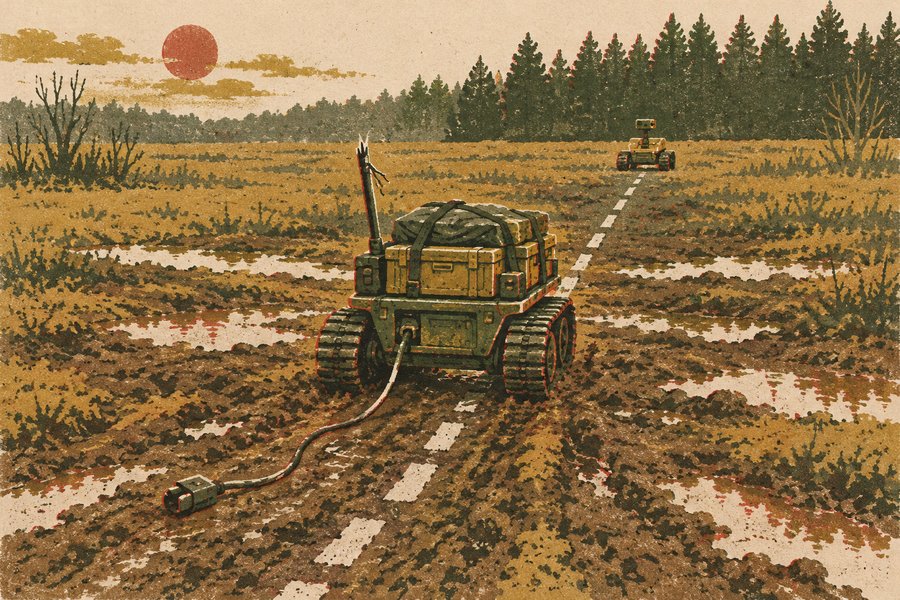
Ukraine's Lava Unmanned Systems Regiment said on Wednesday that one of its ground robots drove itself across nearly 19 of a 20-kilometre frontline supply route with no human at the controls, in what the unit called the first publicly confirmed AI-navigated logistics run under live combat conditions. The regiment, which disclosed the mission through Ukraine's Ministry of Defence media arm, recorded a 93 percent autonomous completion rate; an operator took manual control for only a 1.4-kilometre stretch where the ground exceeded what the robot's pre-built map anticipated.
The central claim is not speed or payload but that the robot needs no continuous radio link, the signal Russian electronic warfare is built to jam. The navigation software, from the Palo Alto and Munich firm Apex.AI, splits the problem across two vehicles. A scout robot drives the route first, scanning it with lidar to build a high-resolution 3D map. The primary vehicle then follows that stored map using only its onboard cameras, matching the live feed against the map to fix its position and steer. An operator still watches on a display and can override at any moment, but is no longer required to drive. When jamming cuts the monitoring feed, the robot keeps going on its own sensors.
Battalion commander Andriy Kopach, call sign "Matematyk," framed the shift in job terms: "The operator stops being a driver and becomes a dispatcher. He doesn't drive the vehicle every second, but monitors the movement and intervenes only where needed." His stated goal is autonomous resupply rather than autonomous weapons, with one soldier eventually supervising several robots at once, compressing the manpower each hazardous delivery demands.
The run lands amid an AI arms race across the same front. In a separate account this week, the Ukrainian firm The Fourth Law described autonomous FPV strike drones whose onboard computers take over target guidance in the last 500 metres, a design its founder Yaroslav Azhnyuk said is "very different from the kind of AI that sits on those data centres that power Claude." NATO, meanwhile, has handed Ukrainian commanders an AI model called Initiative 13 that forecasts the next day's expected Russian drone activity across mapped cells of territory. The common thread is cheap, task-specific AI that sidesteps jamming or predicts it, not the frontier models that dominate most AI coverage.
The scale behind the milestone is what makes it more than a demonstration. Ukraine logged more than 11,000 ground-robot operations in a single month in April, and by late August unmanned ground vehicles had completed over 100,000 logistics and evacuation missions on the front in 2026. The Defence Procurement Agency contracted more than 22,000 ground vehicles in the first half of the year, against President Volodymyr Zelensky's stated target of 50,000 by year-end. Apex.AI went from its first in-country testing in February to this disclosed combat run in roughly eight months, a pace traditional defence procurement rarely matches.
Several claims rest on the regiment's own account and cannot be independently verified, including the 93 percent figure and the assertion that the single manual segment reflected terrain rather than a system failure. The mission is also supervised autonomy, not a fully autonomous machine: a human remained on the loop throughout and the robot carried no weapon on this run. Zelensky has warned that AI could begin leading battlefield decisions as soon as next year. For now the frontier being crossed is logistics, where the open question is how reliably a map built on one pass holds up when the next route, and the next day's jamming, look nothing like the last.