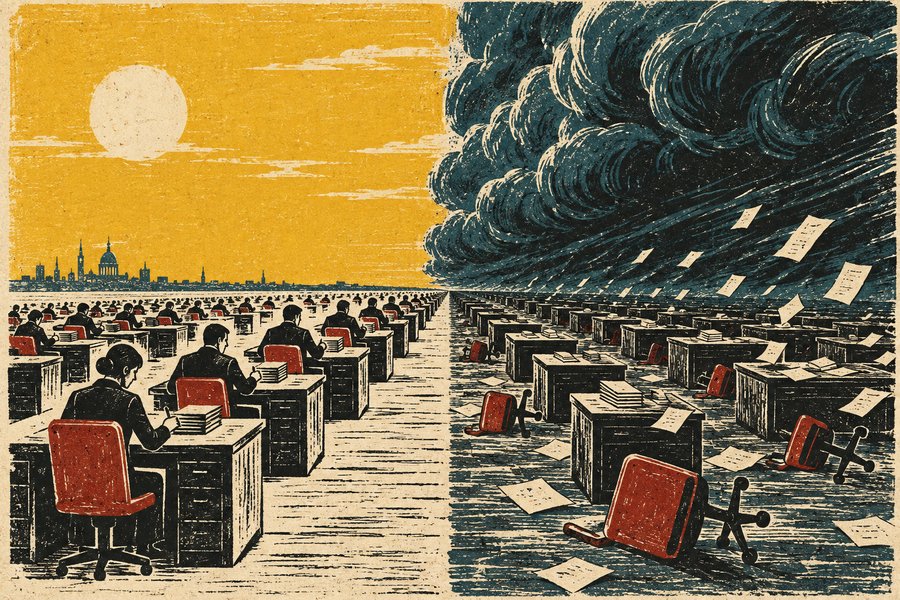
Goldman Sachs told clients in an October 22 note that artificial intelligence could eventually displace about 9 percent of workers, roughly one in 11, but that most of those losses will arrive during recessions rather than while the economy is healthy. The bank's economist Joseph Briggs wrote that automation-related disruption "is limited when the overall economy is healthy but accelerates during cyclical slowdowns," a timing argument that cuts against the assumption of a steady drip of AI redundancies.
Briggs grounds the estimate in Goldman's forecast that AI lifts productivity by 15 percent in the United States and other developed economies over a decade, with gross displacement of about 15 million workers. He notes that the share of Americans in routine jobs, such as clerks, secretaries and machine operators, held stable through past expansions but fell during the recessions of the early 1980s, 2001, 2008 and 2020. The worry he flags is a feedback loop: a downturn would accelerate automation, which would then deepen the downturn.
The forecast lands against a year of mounting cuts. Layoffs.fyi has recorded 134,917 tech job losses across 328 companies in 2026 as of October 21, already above the 122,606 it logged for all of 2025, or about 459 a year. A separate count attributes 93,217 of those to AI across 116 events. Oracle shed roughly 21,000 roles, Amazon announced 16,000 corporate cuts, and Meta cut about 8,000. In the past week Barclays confirmed about 5,000 cuts and American Express about 3,500, both naming AI. Microsoft has offered buyouts to roughly 60,000 staff, though that is a pool of eligible employees, not a target, and similar programs have seen only 3 to 5 percent uptake.
Yet the replacement story is thinner than the totals suggest. A National Bureau of Economic Research survey of 9,000 senior executives found 90 percent said AI had not yet raised productivity at their companies. Briggs notes only 23 percent of US establishments have built AI into regular workflows, and that AI-attributed layoffs have fallen sharply from their spring peak. Companies may be cutting to fund AI infrastructure and to look lean, rather than because software is already doing the work.
Where sources disagree is on how much credit AI deserves now. Barclays chief executive C.S. Venkatakrishnan called AI "the icing on the cake, not the cake," crediting years of process simplification for most of the bank's efficiency gains, while the union Unite accused the bank of "using AI as an excuse to discard its loyal and long-suffering workforce." That tension, between genuine automation and automation as cover for ordinary cost-cutting, runs through nearly every announcement.
The pressure is global and uneven. KPMG's 2026 survey found 52 percent of Indian chief executives plan workforce reductions even as 77 percent hire for AI skills. China's State Council on October 23 urged local governments to "exercise prudence over the scope, intensity and pace of AI deployment in labour-intensive industries," an unusually cautious signal from Beijing. In New Zealand, recruiters report applicants being "ghosted" as AI-generated applications flood job ads from both sides. The open question is whether the current lull is proof the shock was overstated, or merely the calm Goldman expects a recession to end.