Helsing presented Contra on October 26, an AI-controlled air-defence system the European defence company says can detect and coordinate engagements against hundreds or thousands of incoming drones and missiles at once, alongside two new interceptors built to chase down fast jet-powered drones and cruise missiles. The company, which unveiled the system at a new Berlin office, said it has already signed a contract to supply Contra, while the two interceptors remain in testing.
Contra works by fusing radar, electro-optical, infrared and acoustic sensors from different manufacturers into a single air picture, then deciding autonomously how to intercept each target while, Helsing says, leaving human operators in control of targeting priorities. The software layer, called Altra, is designed to keep working under jamming, loss of communications and the failure of individual nodes. Helsing says the architecture can also absorb third-party weapons, including anti-drone lasers, guns and net-based systems, so an operator can match a cheap effector to a cheap threat rather than fire an expensive missile at every drone.
The two in-house interceptors target different threats. The AD-1 Inferno is jet-powered, with a company-stated top speed above 700 km/h and a ceiling over 9,000 metres; Helsing says it can loiter after launch, operate in swarms and re-engage in flight using midcourse updates from ground radar. The AD-2 Ambush uses a solid-fuel rocket motor and is said to reach roughly Mach 2.5 and engage beyond 20 kilometres. Both rely on onboard radar seekers rather than cheaper optical or infrared ones, which Helsing says lets them work in darkness, cloud and fog. All of these figures come from the company, and the interceptors have not yet entered service.
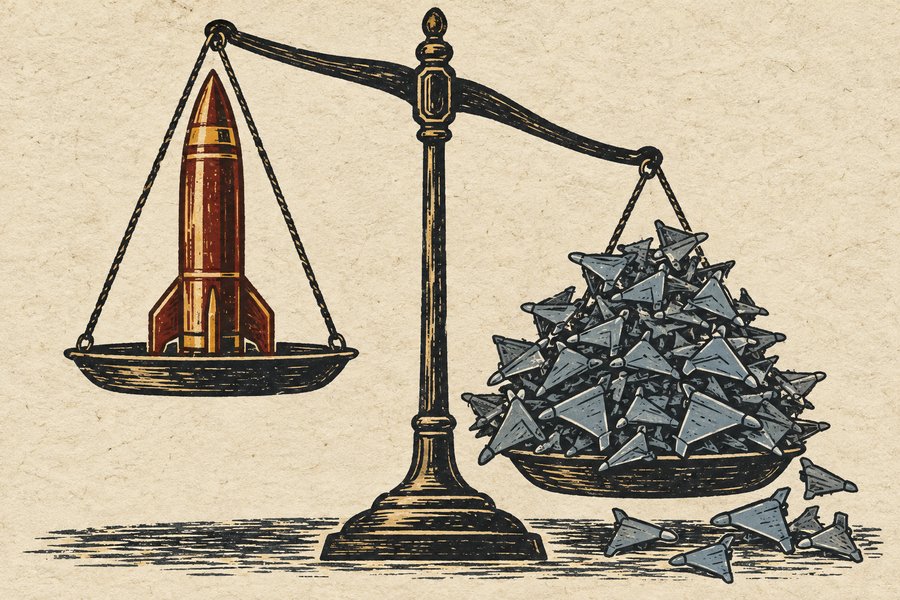
The design is a response to a cost problem that Ukraine is already living. Helsing co-founder Niklas Köhler framed Contra as a way to end "the air defence dilemma: slow fair-weather drones, or million-euro missiles fired at cheap, mass-produced targets." The company cites intelligence assessments that Russia has pushed production of its jet-powered Geran-4 and Geran-5 drones toward 4,000 units a month, faster and harder to stop than the propeller-driven Shahed types that came before. Helsing says both interceptors are meant for mass production through two separate European supply chains, reducing reliance on any single line.
Contra lands in a market being reshaped by how quickly drone warfare now moves. At a NATO exercise in Latvia in August, manufacturers demonstrated interceptor drones built on weekly feedback from Ukrainian units, and a French parliamentary committee has documented a six-week average turnaround for each new battlefield countermeasure. That tempo is pushing NATO members to buy continuously updated "services" rather than fixed stockpiles, and it is pushing AI deeper into the targeting loop, where a system that decides faster than an adversary can adapt has the advantage.
That same speed is what worries arms-control bodies. In a joint appeal in August, UN Secretary-General António Guterres and ICRC President Mirjana Spoljaric urged states to set rules before autonomous machines begin selecting human targets, a question due before a review conference on the Convention on Certain Conventional Weapons in November. Helsing says Contra keeps humans in command of its decisions; where exactly the line sits between coordinating thousands of interceptions and delegating them is the part the company's announcement does not fully resolve.