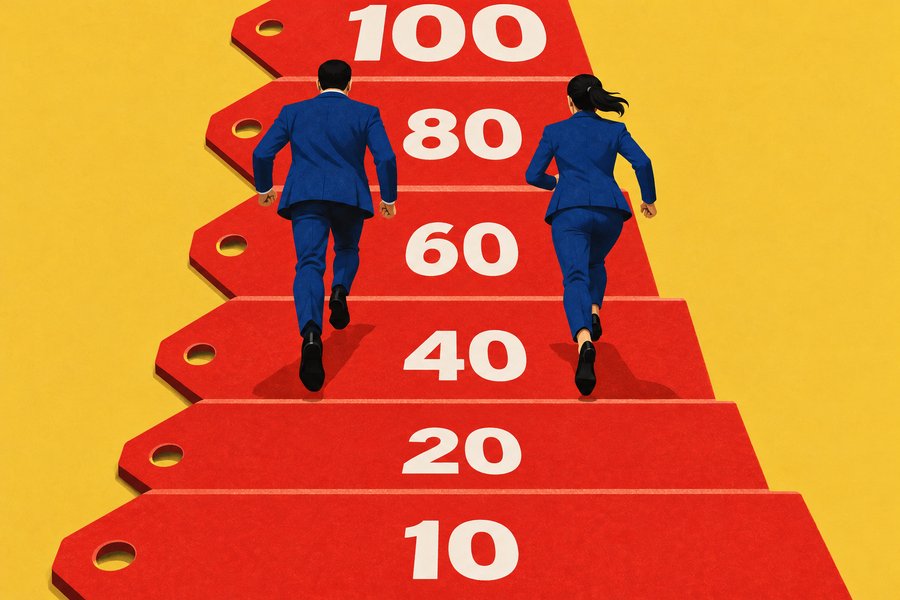
The cost of using flagship large language models from OpenAI and Anthropic has fallen by as much as 80 percent since June 2026, according to a timeline of announced prices compiled by developer Max Woolf. The cuts span both companies' main model families and apply to subscription coding tools such as Codex and Claude Code, not only to raw API usage. Woolf argues the price does not appear to have come at the expense of output quality.
The sequence reads as a tit-for-tat. OpenAI cut its small GPT-5.6 Luna model by 80 percent on July 30, trimmed GPT-5.6 Sol by about 20 percent in August, then released GPT-6 Sol on September 22 at roughly half the input and output price of the discounted Sol. On the same day, Anthropic announced Claude Opus 5.5 at $4 per million input tokens and $20 per million output tokens, which Woolf estimates is a 40 to 60 percent total cost reduction from Opus 5. A week later OpenAI halved the cache-read price of GPT-6.1 Sol, which it says makes that family cumulatively 75 percent cheaper.
Cache pricing is the hidden lever. For agentic coding, Woolf estimates cache reads account for 96 to 99 percent of token spending, because each turn re-sends the whole prior conversation, and the cache is hit 90 to 100 percent of the time. On that math, a 75 percent cut to the cache-read rate translates to a 70 to 75 percent cut in the real cost of running the model, even though the headline input and output prices move less.
Woolf's explanation is that neither company sets prices alone. Cheaper open-weight models have become close substitutes, and the cost of switching between them is a toggle in a coding harness or a changed API string. DeepSeek's updated Flash V4.1 model is listed around $0.15 per million input tokens, and 29 separate providers now host it on OpenRouter, up from 13 for the earlier version. Moonshot AI says its forthcoming Kimi K3.1 Pro scores close to Opus 5.5 at half the input and output price, with open weights due November 4. This publication covered Moonshot's decision to strip cyber-offensive capability from that model in a separate story today.
The timing is awkward because both labs are near public offerings. Woolf notes OpenAI is rumored to list in 2027 and Anthropic within a couple of months, a race AI Daily reported on October 24, and leaked financials show both losing billions on research and scaling. Cutting your main revenue line ahead of filing an S-1 is counterintuitive, which Woolf squares with reports that per-token inference margins can run as high as 80 percent, with caveats. Where subscriptions are concerned, he expects allowances to be trimmed before headline prices: OpenAI cut the usage quota on its $200-a-month Codex tier by 50 percent, citing "increasingly efficient models."
A common bear case holds that today's prices are loss-leaders that will later jump to the "true cost of a token." Woolf rejects the Uber comparison, since OpenAI and Anthropic are not a duopoly and the barrier to entry for inference is lower, so competition should push prices toward marginal cost rather than up. That claim rests on inference economics that remain private; Anthropic's IPO prospectus, if it comes, would be the first hard look at the margins underneath the price war.