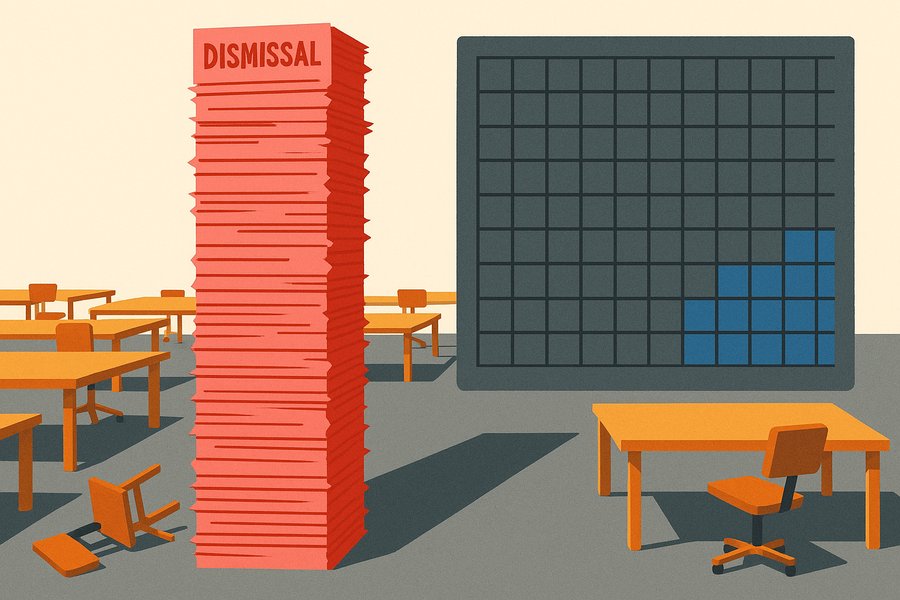
US employers have cut more than 117,000 jobs in 2026 while citing artificial intelligence, eliminating an estimated $8.5 billion in annual wages, even as a new benchmark finds the leading AI agent completes only 15.8 percent of real freelance projects. The Remote Labor Index, built jointly by Scale AI and the Center for AI Safety, tests agents on paid freelance work such as web development and video production. Anthropic's Claude Fable 5 led the index at 15.8 percent; OpenAI's GPT-5.5 reached 6.3 percent.
The wage figure comes from the Center for AI Safety's AI Wage Loss Dashboard, published at wageloss.ai, which aggregates cuts that employers attribute to AI across the United States. The two numbers describe the gap at the centre of this year's labour story: companies are restructuring around a capability that commercial tools do not yet consistently deliver.
The dashboard's authors are explicit about what their figure is not. It records layoffs that employers blamed on AI; it does not verify that AI actually replaced the roles, or that the tools perform as the announcements imply. The Remote Labor Index carries a parallel caveat: its 15.8 percent applies to a tested set of freelance projects, not to every workplace task, and completion rates vary by category. Both datasets are early indicators, not causal proof.
Read together, they still point one way. A Guardian investigation found that 90 percent of surveyed executives said their AI initiatives had not produced measurable productivity gains. If the best-performing agent finishes fewer than two in ten professional freelance jobs on its own, the automation case used to justify many of this year's cuts assumed a level of capability that does not yet exist in shipping products. The jobs are gone; the replacement is partial.
That mismatch echoes a pattern AI Daily covered on 16 October, when the sharper near-term risk looked less like mass displacement than a shift in who holds bargaining power once employers believe a tool can do the work. History offers a longer frame. CNBC this week revisited the automation of AT&T's telephone switchboards, which erased an estimated 75,000 operator jobs, overwhelmingly held by women; economists James Feigenbaum and Daniel Gross found that incumbent operators often moved to lower-paying work, while the next generation adapted and found comparable jobs elsewhere. The International Labour Organization concluded in March that nearly one in ten women in high-income countries works in an occupation at the highest risk from AI.
What remains unverified is whether the current cuts track real substitution or get ahead of it. The headcount reductions are concrete and disclosed. The productivity gains are, so far, mostly asserted. If capability catches up to the announcements, the layoffs will look early; if it does not, employers that cut aggressively will discover the remaining work still needs people, and will have to decide whether to rehire or absorb the shortfall.