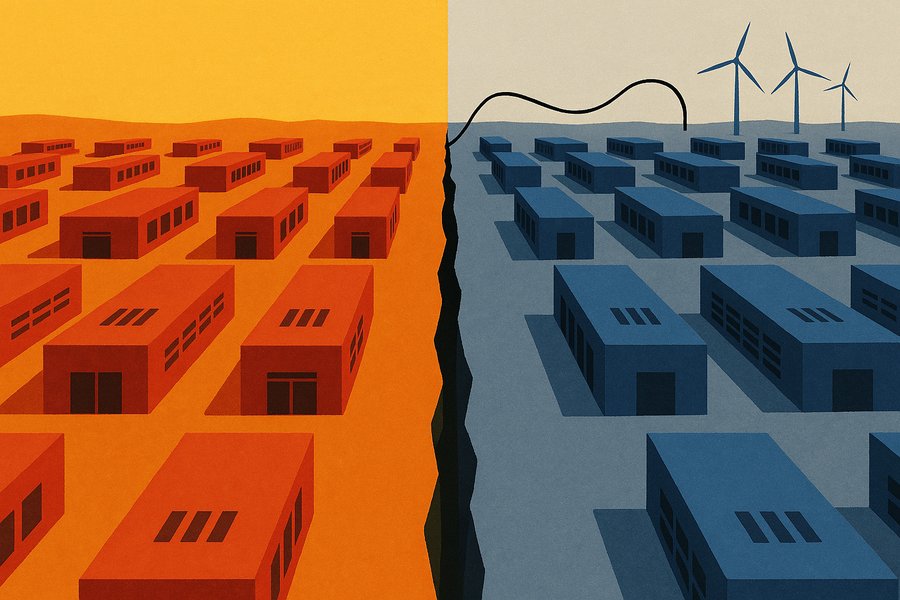
For a while it was possible to talk about "the" AI race, as if there were one track and one finish line. This week that idea quietly gave way to something more specific: two races, running in parallel. Goldman Sachs told clients that the AI trade is splitting into two increasingly distinct ecosystems, one centred on the United States and its trading partners, the other taking shape inside China. On the same days, China's customs office reported that exports leapt 36.3 percent in September, the biggest monthly jump since 2021, powered by a 108 percent surge in semiconductor shipments and a boom in data-processing machines. AI demand, in other words, is now doing much of the work of holding up a slowing Chinese economy.
Goldman's reframing is the clearest sign of how far the ground has moved. China is no longer just a supplier to the Western buildout, the bank argued; it is assembling a full stack of its own, spanning advanced chips, open-weight models and applications. Since the "DeepSeek moment" in early 2025, nearly $5 trillion in market value has been created in Chinese AI equities, which now account for 42 percent of the combined mainland and Hong Kong stock market, up from 24 percent in 2024. The technology gap, Goldman wrote, is narrowing: China still trails at the leading edge of chips, but is "on par with, or even leading" in parts of AI power, infrastructure, models and physical applications.
You can see the second ecosystem being poured into the ground. In Ulanqab, a city of fewer than two million on the edge of the Gobi desert, CNN found block after block of data centres rising from the plains, nearly 90 of them slated for construction, most of the flagship park built in just two years. China's edge here is not chips but electricity and land: abundant, cheap, often green power, so much of it that the country wasted enough clean energy in the first half of 2026 to run Mexico for a year. There is also, crucially, no local opposition of the kind stalling American projects. Beijing has pledged $560 billion over five years for computing infrastructure. Even so, the United States still has roughly ten times as many AI data centres, and Chinese firms will invest around $139 billion this year against $800 billion by their US peers.
The awkward truth beneath the buildout is that China is racing on borrowed silicon. Industry insiders told the Financial Times that Chinese companies bought more than a million Nvidia gaming and workstation GPUs in a single year, export-compliant cards repurposed for AI because domestic production of about 3.5 million chips cannot meet demand that "far exceeds" five million. Part of the pull is Nvidia's CUDA software, still more capable than the homegrown alternatives. That is exactly the dependency Huawei and DeepSeek are now trying to break, announcing a partnership to run DeepSeek's open-source TileLang framework on Huawei's Ascend chips. Huawei's own verdict on what drove the effort: American export controls supercharged it.
Politics is hardening the split rather than softening it. Presidents Trump and Xi agreed to extend a trade truce and open a "dialogue" on AI risks, with the next round due in November, but Trump ruled out any joint venture. "There is nobody in third place," he said. "It is all between us and China." The open question is whether two self-reinforcing ecosystems can coexist, trading and competing, or whether each walls the other out until decoupling is complete. For now China's export boom is papering over a soft domestic economy, and its most ambitious AI plans still run, in part, on chips designed in California.