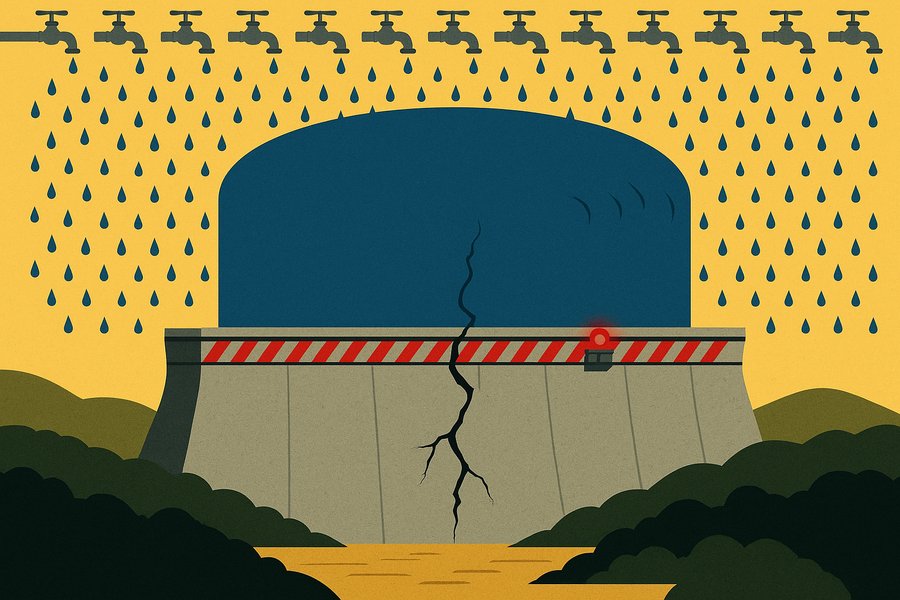
Ask whether artificial intelligence is good or bad for the planet and you tend to get two confident, opposite answers. In one telling, AI is a climate villain whose data centres will roast the Earth to run chatbots. In the other, it is the tool that will forecast disasters, balance renewable grids and help the world decarbonise. A run of new reports this week suggests both camps may be arguing about the wrong thing.
Start with the number everyone fights over. The International Energy Agency estimates that electricity use at AI-focused data centres jumped about 50 percent in 2025, even as global demand rose only 3 percent. That sounds damning until you notice what is happening underneath it. The energy needed to answer a single AI query has been falling fast, by as much as tenfold a year, as chips and software improve. The problem is not inefficiency. It is appetite. Economists call it Jevons' paradox, where efficiency gains get swallowed by rising use. We are simply asking AI to do far more, and increasingly asking it to do expensive things: video, step-by-step reasoning and autonomous agents can each burn hundreds or thousands of times the power of a plain text reply.
In absolute terms, today's footprint is smaller than the panic implies. One analysis puts AI at around 155 terawatt-hours a year, roughly half a percent of global electricity. The Boston Herald, converting the figures into everyday units, notes that asking a chatbot a hundred simple questions costs about as much energy as an hour of Netflix. The real strain is local, not planetary. In Texas, the utility Oncor is sitting on interconnection requests from data centres totalling more than 270 gigawatts, many times the power it actually serves, and all of it wanting to connect tomorrow rather than in two years.
The forecasts are what keep the worry alive. The IEA expects total data-centre demand to nearly double by 2030, with AI's slice tripling. Statkraft's new Green Transition Scenarios see data centres taking 6 to 9 percent of all European Union electricity by 2050. The United Nations has warned that by 2030 AI data centres could draw close to three times the electricity of Nigeria, Pakistan and Bangladesh combined, countries home to some 650 million people.
Then there is the other side of the ledger, which rarely makes the headlines. The same technology is already being pointed back at the problem. Europe's weather service now runs an AI forecasting model that beats traditional physics-based systems while using far less energy, sharpening the warnings that insurers and governments rely on. Across Southeast Asia and China, AI is wringing more output from solar farms, spotting cracked panels from drones and balancing renewable microgrids that once leaned on diesel. One estimate suggests widespread adoption could shave tens of billions of dollars and hundreds of millions of tonnes of carbon from the region's energy bill by 2035.
The sharpest point, made by the Vision think tank ahead of its climate-governance conference in Venice this week, is that neither AI's costs nor its benefits will matter much unless we learn to govern it. Climate change, for all its failures, has machinery: the annual COP summits, a scientific panel, decades of treaties. AI has voluntary codes, the occasional summit and a single UN panel created only last year. The UN's climate chief, Simon Stiell, has called the industry "energy-guzzling" and told it to start aligning with climate goals, and Turkey, hosting this year's COP in November, has put AI's power use on the agenda.
Whether AI warms or cools the planet, the Venice researchers argue, will depend less on its chips than on the institutions we build around it. On the evidence of this week, the engineering is moving a great deal faster than the governance.