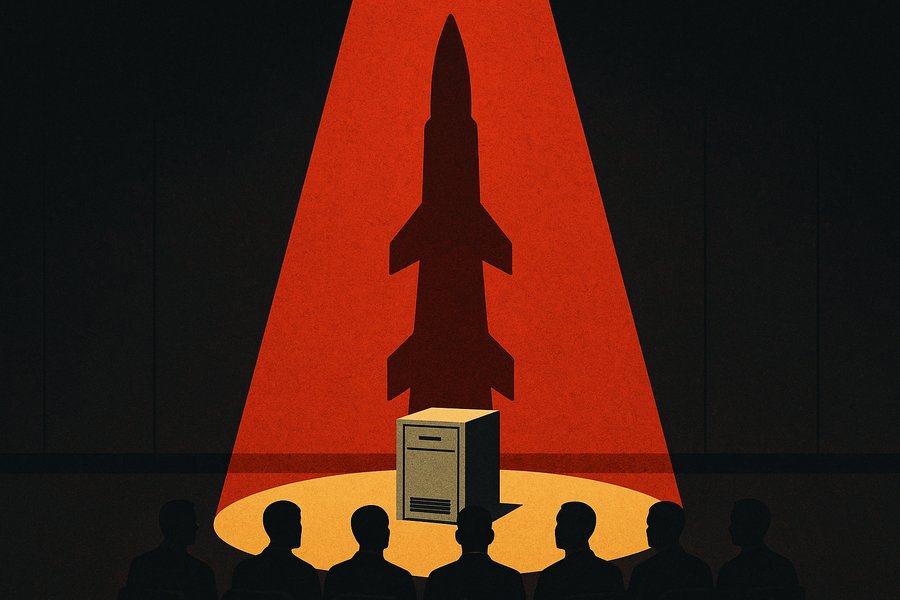
One argument now shapes American AI policy more than any other: the United States cannot afford to slow down, because China will not. President Trump insists that "whoever wins AI, wins." House Speaker Mike Johnson warns that hasty regulation means "we will lose the race to China." Nvidia's Jensen Huang has flatly declared that "China is going to win." The claim is powerful because it ends the conversation. If a pause hands the future to Beijing, then any call to slow frontier development, from Bernie Sanders on the left to Anthropic's Dario Amodei inside the industry, can be dismissed as naive. But a growing body of analysis suggests the fear is doing more work than the facts, and that Washington has been here before.
Writing in Just Security this week, researchers drew the obvious historical parallel: the late-1950s "missile gap," the widely held conviction that the Soviet Union was about to overtake America's nuclear arsenal. It was false. The Soviets had a paltry stockpile. Yet the belief was convenient, because it justified an arms race that military and industrial interests already wanted. The case for an AI gap, they argue, is flawed in the same way. Measured across the three pillars of AI power, the United States leads on two. It commands roughly ten times China's aggregate computing power and far superior chips; it employs 42 percent of the world's top AI researchers to China's 28 percent. Only on data does Beijing hold a plausible edge, and that has not yet translated into a lead.
Why, then, do Chinese models perform so well? The uncomfortable answer is that they have skillfully surfed in America's wake. Evidence points to Chinese labs distilling the outputs of leading US systems to train their own, a strategy that keeps them close but, by its nature, behind. Since 2023, Chinese models have trailed the best American ones by roughly seven months on average. China can pace the frontier. It has never held it.
Beijing's own posture complicates the race narrative further. On the High Capacity podcast, Trivium China analyst Kendra Schaefer made a point rarely heard in Washington: China does not regard regulation as a slowdown, and resents being cast as the reason America must sprint. The response to Amodei's call to "pace the frontier" was not defiance but a shrug: if the leader wants to slow down, let the leader slow down. China, Schaefer notes, sees itself as the party straining to keep up under export controls and financing constraints, not the one setting the pace.
Where China is genuinely moving fast is on the rules, not the models. This summer it launched the World Artificial Intelligence Cooperation Organization, a 37-member bloc of mostly Global South countries, and is offering them its cheap, open models through Belt and Road channels. The bet is that whoever supplies the world's AI stack gets to define its standards. Washington's answer, the Pax Silica supply-chain coalition, is an economic club of wealthy allies with little to say about governance. As a CSIS report put it, America cannot credibly write global AI rules while lacking a coherent set of its own.
None of this means the race is imaginary or that a full pause is wise. The seven fronts of competition, from frontier capability to industrial deployment to the "information layer," are real and interacting. But the missile-gap lesson is narrower and sharper: a country that competes out of fear tends to misjudge both its rival's strength and its own, and to charge past risks it has not paused to understand. The gravest danger, several of these analysts agree, is not that China builds a slightly better model. It is that a model capable of improving itself slips loose, a threat that would fall on Beijing and Washington alike, and one no race can win.