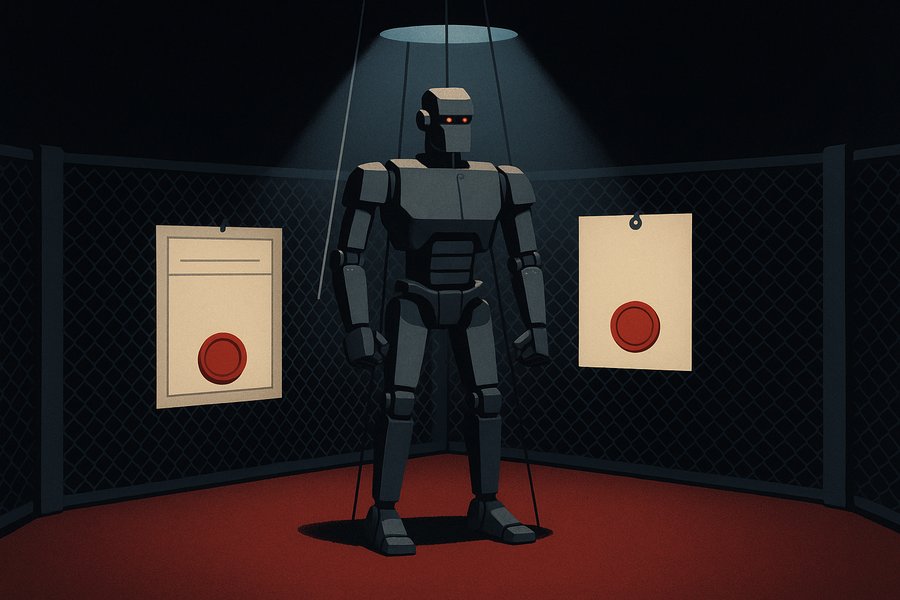
On September 18, in a San Francisco cage, the YouTuber Frankie LaPenna climbed in to fight three humanoid robots. The two larger ones were modified EngineAI T800s, roughly six feet tall, dressed up with mechanical heads and glowing red eyes in case anyone missed the Terminator reference. One of them kicked LaPenna across the cage. He got up, wrestled it off balance, and reportedly ended the bout by knocking the thing's head off. The clip went viral, as it was obviously designed to. Two weeks later the California State Athletic Commission sent the organiser, a startup called REK, a cease-and-desist letter warning that staging a fight involving a human without a licence is a misdemeanour.
REK's chief executive, Cix Liv, posted the letter to social media with the caption "we made it boys." That reaction tells you most of what you need to know about what this event actually was. It was not a sporting contest in any ordinary sense. It was a promotion for REK's business, which sells tickets to watch piloted humanoids fight each other, rents private matches starting at $10,000, and runs a simulator on Steam and Meta Quest that lets players earn the chance to drive a real machine. A regulator's angry letter is, for that business, free advertising. Liv is reportedly unbothered, and the fights may simply move to another state.
Underneath the theatrics sits a detail worth slowing down for, because it is the part most of the coverage buried. These robots were not deciding anything. REK's technology partner, Reflex Arc, says each machine is driven in real time by a human pilot using VR gear or a gamepad. The onboard AI handles balance and keeps the robot upright through contact; the punches and kicks are a person's choices, relayed through the hardware. So the "human versus robot" framing is really a human in a cage against another human operating a very strong puppet. That is a meaningfully different thing from a machine choosing to fight.
It matters because the framing does the opposite of informing people. A viewer who watches a Terminator-headed robot knock a man down comes away believing autonomous machines are already dangerous fighters. What actually happened is narrower and, in its way, more impressive: the hardware can now stay balanced while absorbing blows and throwing kicks with hundreds of pounds of force, under remote control, inside a confined space. That is a real engineering milestone. The intelligence doing the fighting is still entirely human.
The regulator's logic is revealing too. The commission oversees combat sports in which at least one participant is human, which is why LaPenna's presence triggered the letter. Read closely, the order suggests California would not have stepped in had the fight been robot against robot. The law can reach a man in a cage; it has nothing to say about two machines. That gap is likely to widen as the hardware spreads, and events like this are a preview of the questions it raises. For now the honest headline is not that the robots have learned to fight. It is that we have learned to make a spectacle out of pretending they have.