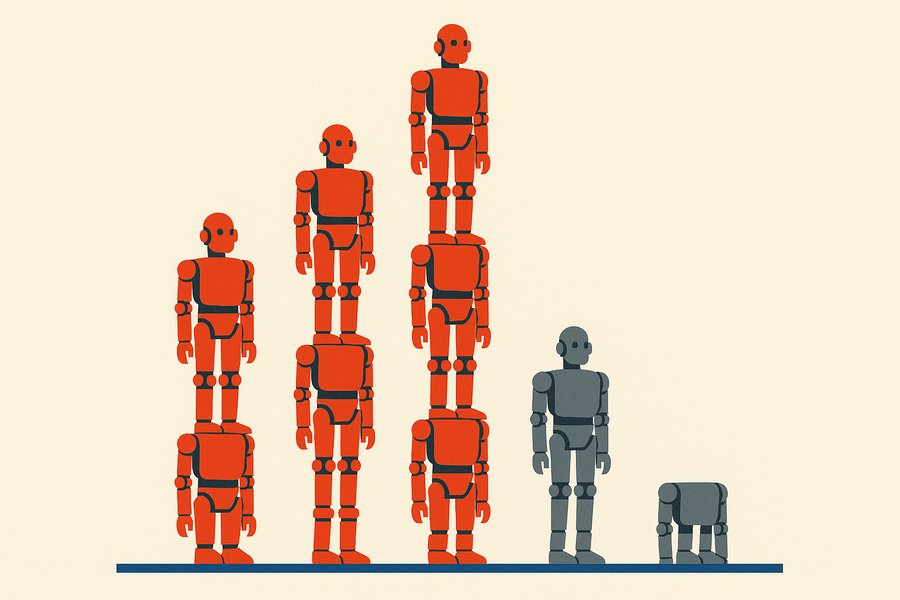
For years, humanoid robots were mostly a video genre: a machine doing a backflip, a robot folding laundry very slowly, a demo that never quite turned into a product. This week the numbers caught up with the hype. Two research firms released shipment trackers for the first half of 2026, and whatever quibbles you have with their methods, they tell the same story. The industry has stopped being a showreel and started being a supply chain.
IDC counted roughly 25,000 humanoid units shipped worldwide in the first six months of the year, up 432 percent from the same period in 2025, with the market topping $740 million. A second firm, Smart Analytics Global, put the tally lower, at about 19,100 units, but still up 272 percent. Either way the sector more than tripled in a year, and IDC was impressed enough to lift its 2030 forecast to more than 750,000 units, roughly half again higher than its previous guess.
The dominant fact underneath those figures is geography. China shipped more than 19,000 of the units IDC counted, around 78 percent of the global total; the more aggressive estimate from Smart Analytics credits Chinese manufacturers with over 97 percent of volume. The reason is not mystery, it is proximity: China has the component makers, the AI model companies and the system integrators all iterating in the same ecosystem, which keeps pushing costs down and output up. The pecking order is shifting just as fast. A firm called Agibot, which shipped more than 8,600 units in the half, has overtaken Unitree to become the largest humanoid maker in the world by both shipments and revenue. A year ago Unitree wore that crown.
Europe, tellingly, has decided it may not need to win the robot to profit from it. A study from Germany's Fraunhofer Institute for Manufacturing Engineering and Automation argues that beneath every humanoid's sleek casing sits a great deal of old-fashioned industry: motors, gearboxes, bearings and precision joints that German suppliers have made for decades. The strategy it floats is unusual and a little humbling: do not build the machine, build the parts it is made of, and sell them to whoever does.
Militaries and police forces are not waiting for the market to mature. The US Army named five winners of its xTechHumanoid competition this week, chosen from 103 submissions after finalists demonstrated power, sensing and autonomy systems at Quantico, with the stated goal of pulling soldiers out of dangerous and physically punishing work. Singapore went further, committing $100 million to a new Home Team Humanoid Robotics Centre and promising to put robots alongside hazmat, prison and forensics officers by 2028, framed carefully as support rather than replacement.
The discordant note comes from the people who study these machines for a living. Aaron Ames, who directs Caltech's Center for Autonomous Systems and Technologies, warns that almost none of the humanoid companies are seriously thinking about safe deployment, and that without clear standards "someone will inevitably get hurt." The parkour flips and sword routines, he notes, are performance, not evidence of safety. There is a fittingly strange coda to the churn: Figure, retiring its older F.02 fleet, trained the robots to leap into a 75-ton electric arc furnace in Finland to destroy their proprietary hardware, a disposal method endorsed, improbably, by Arnold Schwarzenegger. The hardware cycle is now fast enough that this year's robots are being melted down before the rules for using them exist.