The most honest thing said about AI and jobs this month was said in a room where nobody had to give their name. At Digiday's AI Marketing Strategies event on 24 September, under Chatham House rules, the owner of a mid-sized performance marketing agency put it plainly: "We haven't hired college-level grads in some time, and I don't anticipate that we will be." He was not angry about it. "It's not like I don't like college grads. I do. It's just a business issue." The tasks that once justified a junior salary, he explained, no longer need one attached.
That admission matters because it contradicts the headline everyone reached for. In May 2025, Anthropic's Dario Amodei warned that AI could erase half of entry-level white-collar jobs and drive unemployment above ten percent. Unemployment last month was 4.1 percent, so the warning reads like a false alarm. It is not. The damage is showing up somewhere the alarm did not point. Companies are not marching people out; they are quietly declining to let them in. A layoff makes the news. A job that is never posted does not.
The numbers underneath are specific and consistent. Stanford researchers tracking payroll records found that hiring of 22-to-25-year-olds in the occupations most exposed to AI has fallen by roughly a third since 2021, while their older colleagues in the same jobs were barely touched. Harvard researchers found the same fork inside adopting companies: junior hiring dropped while senior hiring held, and the tasks AI can do were quietly edited out of the job descriptions written for beginners. The signal is not confined to America. Ireland's ICT sector shed 20,000 jobs year on year. South Korea's central bank reported that 94 percent of youth jobs lost over four years came in industries heavily exposed to AI.
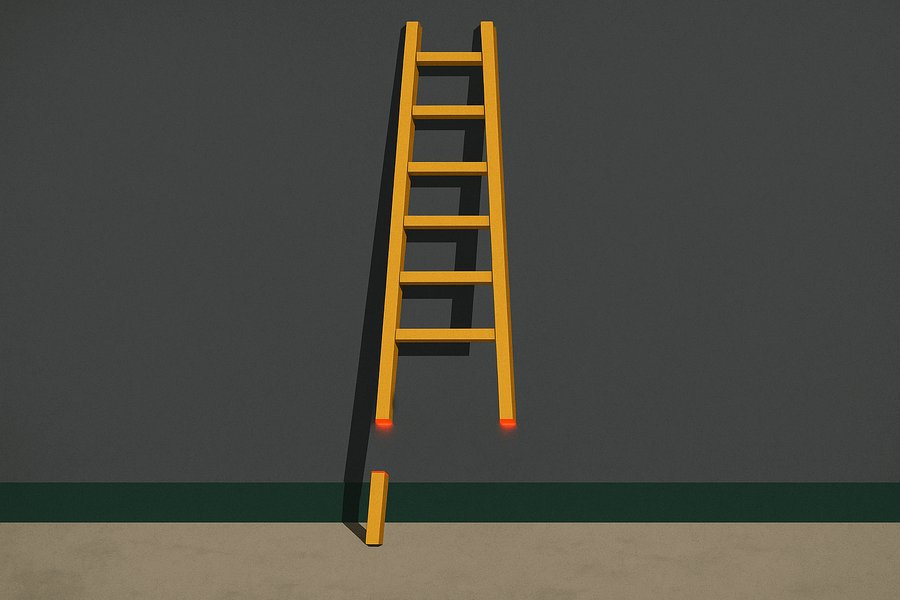
What makes this more than a hiring blip is what an entry-level job actually was. It was an apprenticeship paid for with grunt work: you pulled the report nobody senior wanted to pull, built the keyword list, drafted the first version of the contract, and in exchange you sat in the room and watched how decisions got made. The tedious work was the tuition. Remove the rung and you do not just save a salary line; you remove the years in which somebody learns why a recommendation is wrong, which is a different skill from noticing that it is wrong.
There is a cruel symmetry here that the town hall circled all afternoon. The one thing that protects a worker from AI is experience, the judgment built over years that the models cannot yet reproduce. And experience is precisely what young people can no longer get, because the tasks that used to generate it have been absorbed. A technology that replaces junior work while rewarding senior judgment ends up drawing down the very supply of judgment it depends on. It works fine for a few years. Then a cohort of thirty-year-olds arrives who never got the reps.
Policy is a slow instrument pointed at a fast problem. Senators Lisa Blunt Rochester and Ted Budd have filed the National Talent Strategy Act, which would force the government to map its 150-plus workforce programmes and, for the first time, name "workers displaced by automation or artificial intelligence" as a planning category rather than a hypothetical. It is the right instinct arriving several hiring cycles late. The agency owner who said he does not expect to hire graduates was describing a decision already made. The 22-year-old sending out her 200th application is not failing. The first rung she was promised quietly stopped existing, and nobody has told her yet.