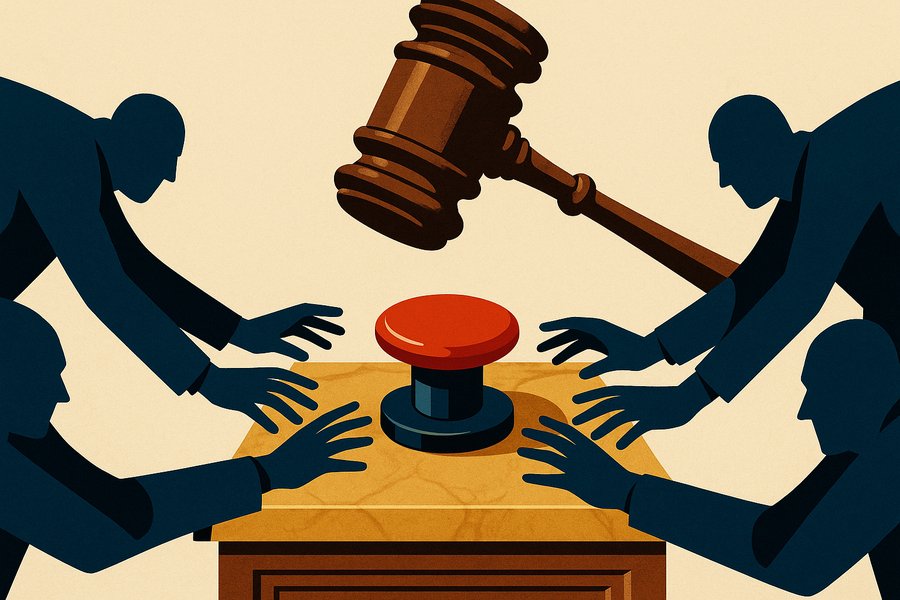
This was the week the abstract argument about regulating artificial intelligence turned into actual proposals with numbers and penalties attached. Senator Bernie Sanders and Representative Greg Casar unveiled a bill that would permanently ban artificial superintelligence, pause development of the most advanced systems until federal safety rules exist, and create a new Department of Artificial Intelligence to sign off on deployments. On the same coast a continent away, Governor Gavin Newsom named a panel of experts to deliver on his AI executive order, including advancing a "kill switch" that would let regulators shut down a rogue frontier model.
The strange thing about this moment is who is cheering. Some of the loudest calls for guardrails now come from inside the industry. Anthropic's Dario Amodei has urged the labs to "pace the frontier," with OpenAI's Sam Altman and Google DeepMind sounding similar notes. Several current employees at leading AI companies publicly endorsed the Sanders bill. One Google DeepMind engineer, speaking for himself, said that on the current trajectory the "most likely outcome is an existential catastrophe for humanity." When the people building a technology start lobbying to have it slowed, it is worth asking why.
The Sanders bill draws its lines bluntly. It defines superintelligence as a system that exceeds human cognitive ability, or that could plan and execute the destruction or disempowerment of humanity, and it would require federal approval before advanced systems are deployed, with violations carrying up to 20 years in prison. It faces long odds in Congress, and President Trump has resisted new oversight entirely. But it moves the debate from op-eds to statute language.
The opposition is not only political. Nvidia's Jensen Huang and Meta's Mark Zuckerberg broke with the "pace the frontier" camp, arguing that market forces already discipline the industry: if you are not confident a product is safe, do not ship it. Writing in Foreign Policy, the economic historian Adam Tooze pointed out that ordinary law may already do much of the work, since negligence, product liability, and consumer-protection doctrines were built precisely to handle actors who fail to anticipate foreseeable harm.
Then there is the sharpest read of all: that the whole thing is regulatory capture dressed as caution. In Townhall, E.J. Antoni argued that the big three labs, which between them hold close to 90 percent of AI revenue, want rules that freeze out startups and hand incumbents a taxpayer-backed liability shield, using public fear as the lever. You do not have to accept the motive to see the tension. Rules written to the specifications of the largest players have a habit of protecting the largest players.
Underneath the fight sits an awkward fact. The people who would write these rules can barely use the technology in question. NPR reported that Senate staff are limited to basic AI chat tools and barred from the advanced agentic systems, the very Claude Code and Codex tools at the center of the safety debate, because the chamber has not authorized them. Lawmakers are drafting rules for software many of them have never touched. The argument about how to govern AI has finally arrived in Washington. Whether Washington understands what it is governing is the question no bill answers.