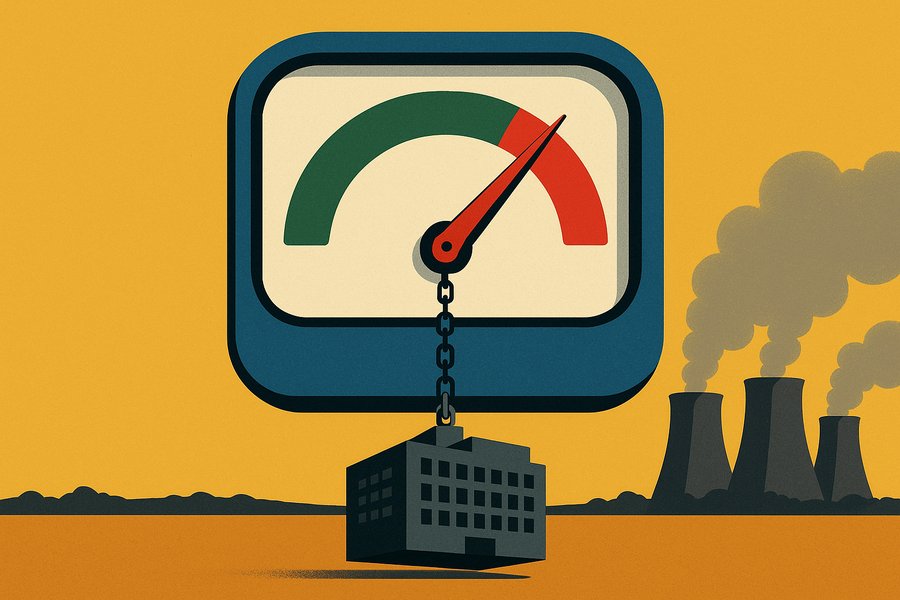
For years the villain of Climate Week wore the same coat: the fossil fuel industry, cast as the thing standing between the world and its targets. This week in New York, a newer defendant took the stand. UN climate chief Simon Stiell told an audience that "energy-guzzling artificial intelligence is driving up planet-heating pollution from coal, oil and gas, while ratcheting up energy costs for households and businesses," and warned that AI leaders are now "on thin ice when it comes to license to operate, and sinking deep underwater when it comes to public support." One analyst quoted by the Associated Press put it more starkly still: in these rooms, AI is becoming more vilified than the oil companies themselves.
The rhetoric arrived with a policy attached. Türkiye, which hosts the COP31 summit in Antalya in November, used the sidelines of the UN General Assembly to launch what it calls the Antalya Pledge on Artificial Intelligence, a "political" commitment on how AI is designed, procured, powered and measured in support of climate goals. "It is time for governments to start setting the terms," said COP31 president Murat Kurum. "We expect companies to be transparent about their energy use and to power their operations with clean energy." No draft text exists yet, the pledge will be voluntary, and it sits on the summit's parallel "action agenda" rather than in the formal negotiations. In other words, it is a signal of intent, not a binding rule.
What gives the signal weight is the physical reality underneath it. New estimates compiled by Climate Crisis 247 put the Colossus 2 facility near Memphis at roughly 946 megawatts of IT power, comparable to the entire electricity demand of Houston. Amazon and Anthropic's Indiana site lands near the same mark. US grid power flowing to large data centres hit about 64 gigawatts in 2025, nearly triple the 2020 level, and the Department of Energy's Berkeley Lab now projects data centres could draw between 9.5 and 15.3 percent of all US electricity by 2030. The abstraction of a chatbot reply turns out to have an address, a substation and a growing line on somebody's power bill.
That last point is why the backlash has legs. This is no longer only a story about distant emissions curves; it is showing up in monthly budgets. In PJM, America's largest power market, data centres added an estimated $3.8 billion to operating costs this summer. Protests targeted Amazon, OpenAI and Google offices in New York, and a former Amazon engineer told Democracy Now that the company's claim of 100 percent renewable power was, by her group's own accounting, closer to 22 percent once renewable energy credits were stripped out. When electricity bills jump and a data centre is rising down the road, the connection writes itself.
Washington is pulling hard in the opposite direction. The Environmental Protection Agency has moved to scrap Biden-era greenhouse gas limits on power plants and is weighing the removal of reporting requirements for smaller polluters, a category that includes the on-site gas turbines many data centres now run while they wait years for a grid connection. As The Register's reporters noted, that could mean unrestricted emissions from new sites that the public never even hears about. The stated justification is winning the AI race with China, where coal still supplies roughly 70 percent of the power behind the data centres.
The defence, predictably, is that AI will pay back its energy debt with interest. The International Energy Agency estimates that AI applications could cut more emissions than data centres add; an MIT researcher told reporters the facilities are perhaps five years from water-neutral and a decade from carbon-neutral operation; and Nvidia is pitching efficiency tools that let a grid claw back power during demand spikes. Critics answer that comparing theoretical future savings against real present growth is a rigged scoreboard, especially when oil and gas firms are among the keenest users of AI to pump fossil fuels faster. That is the tension COP31 will inherit: a technology sold as part of the climate solution, drawing power like a small nation, defended and attacked with numbers that describe two different futures.