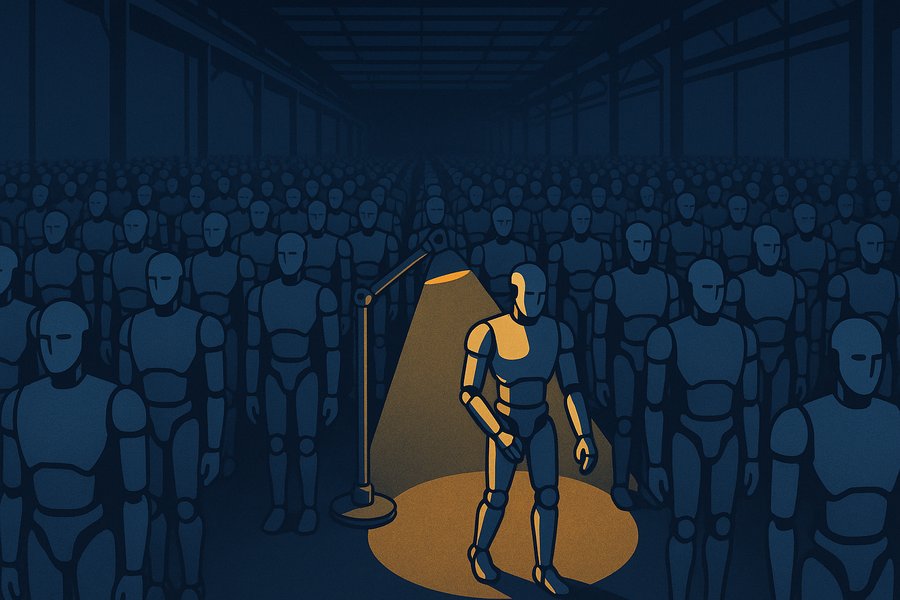
Here is a number worth holding onto while the promotional videos play. The International Federation of Robotics, which has tracked the industry for three decades, has produced its first-ever count of humanoid robots, and the figure it shared with Reuters this week is roughly 7,000 sold worldwide in 2025 for industrial and professional use. For comparison, the same body counted about 542,000 conventional industrial robots installed in 2024. The humanoids, in other words, remain a rounding error. And there is a sharper caveat buried in the data: many of those 7,000 were not doing productive work at all. They were bought by research institutes and companies to generate the training data that might, one day, let them work.
That reality landed in the same seven-day window as the spectacle. At Salesforce's Dreamforce conference, Figure AI founder Brett Adcock agreed with his host that his company is "building a new species." In Liuzhou, in southern China, UBTECH opened a factory calibrated to complete one industrial humanoid every ten minutes. Dongfeng confirmed its Xiaodong robot will enter an automotive plant in October. There was even a caged "Human VS Terminator" bout in San Francisco, staged by a startup building a combat video game. Read the headlines and the androids are already here. Read the ledger and they have barely arrived.
The gap between those two pictures is not spin, it is the actual state of the field. UBTECH's ten-minute cadence is a designed benchmark for a line running at full tilt, not a measure of sustained output, and the company's own disclosures put its flagship Walker S2 at roughly 50 percent of a human worker's efficiency. Carmakers, the supposed early adopters, are running pilots with "single-digit or sometimes double-digit numbers of robots in their plants," the IFR's Susanne Bieller told Reuters. America's best-known names are smaller still: Tesla's Optimus program, Figure, and Agility each shipped around 150 units in all of 2025.
Where the machines are being built, however, is no longer in doubt. Chinese companies accounted for an estimated 97 percent of global humanoid shipments in the first half of 2026, led by AgiBot and Unitree. That dominance has already curdled into geopolitics: in late July the US Federal Communications Commission added humanoid robots to its Covered List, blocking new imports on the grounds that internet-connected machines subject to China's National Intelligence Law pose an "unacceptable cybersecurity and safety risk." So the country setting the production pace is also the country whose robots Americans can no longer legally buy new.
Strip away the marketing and a consistent theme emerges: what these robots need most right now is not jobs but data and human hands. 1X says its home robot NEO will ship autonomous "by default," yet owners can summon a human teleoperator to take over unfamiliar tasks, and a small industry has sprung up paying people to film themselves doing chores so the models have something to learn from. The dominant use of a humanoid robot in 2025 was not labour. It was rehearsal.
None of this means the forecasts are wrong. Bank of America Global Research expects 90,000 humanoids to ship this year and 1.2 million by 2030, and the manufacturing muscle in Liuzhou is real. But a daily briefing owes its readers the honest snapshot underneath the projections, and the snapshot is this: a technology capable of genuinely startling demonstrations, deployed at a scale that would fit inside a single mid-sized warehouse, still learning to do the work it has already been promised for.