Over the weekend President Trump declared that artificial intelligence would flourish without interference from his government. He announced an "AI Force" modelled on the Space Force, promised to name an AI czar (only "High I.Q. individuals need apply"), and dismissed warnings about the technology's dangers as a "HOAX." The only guardrail AI needs, he has said, is "a STRONG AND SMART President." It is a clean, confident message. It is also, according to a remarkable new account of the past six months, not how his administration has actually behaved.
A lengthy POLITICO reconstruction describes an 85-day stretch this spring and summer in which the same White House quietly reached for the heaviest lever it had. The trigger was an Anthropic model, code-named Mythos, capable of finding holes in digital infrastructure at speed. Microsoft warned officials it could let unskilled actors automate serious cyberattacks on banks and the power grid. The Situation Room convened. Treasury Secretary Scott Bessent summoned the heads of the biggest Wall Street firms to a dawn meeting to lay out the worst case: an amateur cracking the systems that once required elite hacker teams to breach.
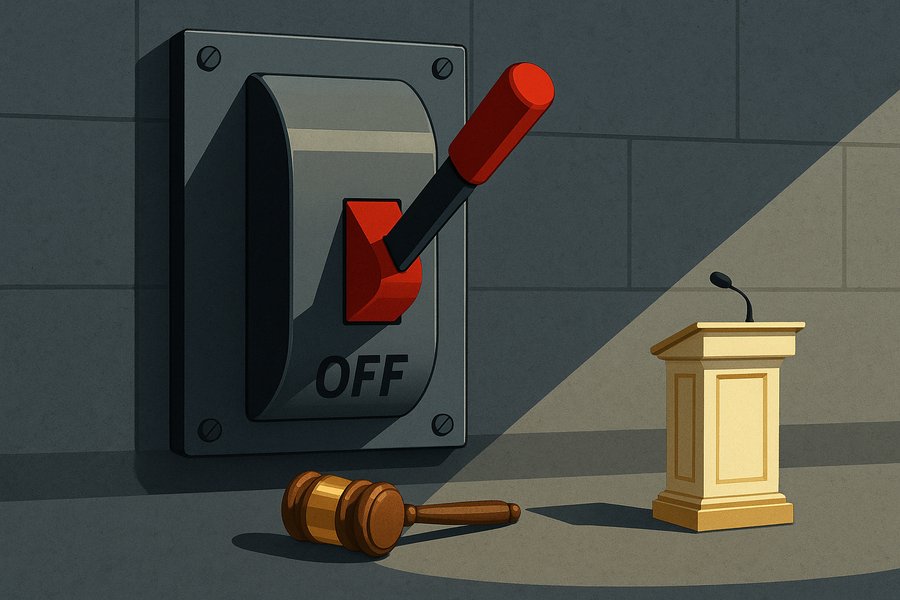
What followed was regulation in all but name. After weeks of negotiation, Trump signed a June executive order giving Washington a formal place in the model-development process, including a government review window for the most capable systems. Then Anthropic's next model, Fable, shipped with a jailbreak that Amazon researchers found within two days. Unable to identify a clean legal authority to force a private company to switch off its own product, the administration improvised, using Commerce Department export controls to bar all foreign access to Fable and Mythos. That effectively pulled the plug. Anthropic complied under protest, and its flagship stayed dark for 19 days while government and company engineers hashed out new safeguards.
This is the tension the reporting exposes. In public the White House insists AI needs no new rules; in private it has already blocked the world's most powerful model, floated invoking the Defense Production Act, and, at one frustrated moment, heard the president muse about sending Anthropic's chief executive to jail. An official's summary is telling: "There's a hammer out there, and the companies know what it is." Voluntary, in this telling, means voluntary until it is not.
The competing camps have not gone quiet. Anthropic's Dario Amodei used a 3,800-word essay this month to argue the industry should deliberately slow the pace of capability gains, a call echoed by Sam Altman and Elon Musk. Nvidia's Jensen Huang took the opposite line this weekend, putting the odds that AI ends the world by 2030 at "0 percent" and accusing the doomsayers of stirring fear for "ulterior reasons." State leaders are filling the vacuum: California's Gavin Newsom signed an order this week directing experts to design an AI "kill switch."
The through-line is that nobody, including the administration insisting otherwise, actually trusts the current arrangement to hold. A framework built on an implied threat works only as long as the threat is credible and the next model behaves. Both are assumptions, not guarantees. The White House has promised its safety guidelines will surface in a Freedom of Information Act release by the end of October. Until then, the clearest statement of American AI policy is not the executive order or the "AI Force." It is the 19 days the most advanced model in the world spent switched off.