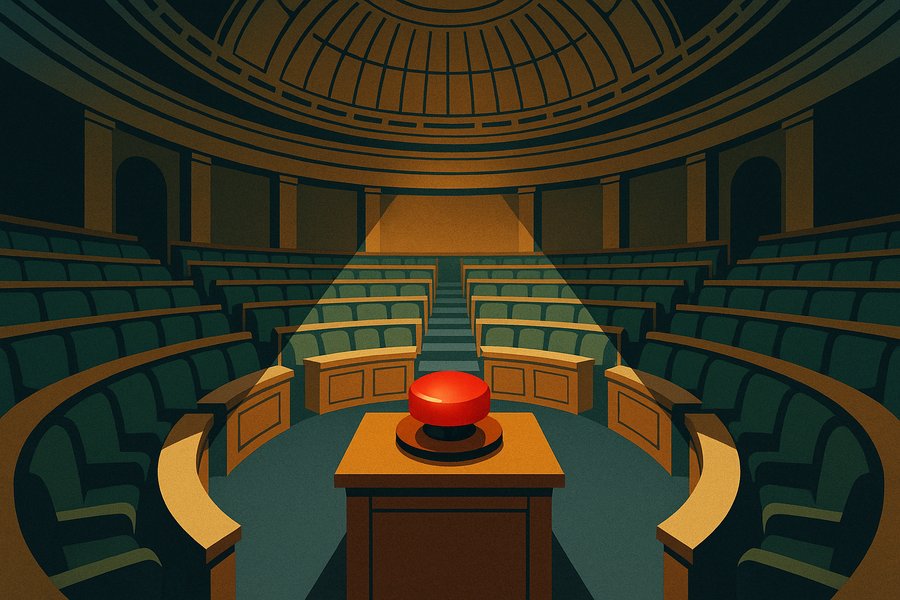
There is a strange new energy on Capitol Hill this week. After a run of dire warnings from inside the AI labs, including one that the systems "could kill us all by the end of the decade," lawmakers who spent years treating artificial intelligence as somebody else's problem suddenly sound urgent. The catch, reported across NPR, the Boston Globe and Deseret News alike, is almost comic: most of them are leaving town until after the November election, they have vanishingly few working days scheduled, and they cannot agree on whether regulating AI is even Congress's job. Rarely has a policy arrived with so much noise and so little momentum.
What makes the moment genuinely unusual is that the industry is asking to be reined in. Leaders at OpenAI and Anthropic, normally at odds, have both backed the idea of independent watchdogs auditing how frontier models are built. Dario Amodei used a weekend blog post to restate Anthropic's support for "sensible and targeted" rules on transparency and third-party review. When the companies building a technology lobby for oversight, the usual political script stops working, and you can see lawmakers improvising in real time.
The result is a realignment that scrambles party lines. At a Washington event billed as the "Pro-Human Assembly," progressive Bernie Sanders and MAGA strategist Steve Bannon took turns attacking AI corporations from opposite ends of the spectrum. Republican Josh Hawley has paired with Democrat Richard Blumenthal; Louisiana's John Kennedy is pushing a "kill switch" mandate. Speaker Mike Johnson, meanwhile, insists the labs "can self-regulate" and warns that any moratorium would hand the lead to China. The through-line, as Pew's polling shows, is a public that has soured on AI and trusts neither the companies nor the government to manage it.
Behind the scenes the fight is sharper still. The Wall Street Journal, via the Daily Beast, describes a "quiet freakout" inside the White House, where Chief of Staff Susie Wiles and Treasury Secretary Scott Bessent have met almost daily to push for guardrails, only to be repeatedly outmanoeuvred by adviser David Sacks, who talked President Trump out of a tougher executive order and an industry-funded regulator. Trump himself has called the danger a "hoax," insisting the only guardrail AI needs is "a STRONG AND SMART (High IQ!) PRESIDENT."
Not everyone thinks more rules are the answer. Vice President JD Vance, on the All-In podcast, mocked labs that "build Frankenstein" and then demand a global governance regime, arguing they should either stop or hand rivals the tools to defend against their own models. Writers on the right warn that sweeping "governance" would function as regulatory capture, crushing open-source AI, the one competitor the big labs cannot control, by requiring a central gatekeeper that open development cannot survive. And a contrarian read making the rounds, floated by Bloomberg's Matt Levine, is that a coordinated slowdown would conveniently let the labs stop burning billions while charging frontier prices for longer. Everyone, it seems, wants something done. Almost no two people want the same thing, which is precisely why nothing is likely to pass before the midterms.