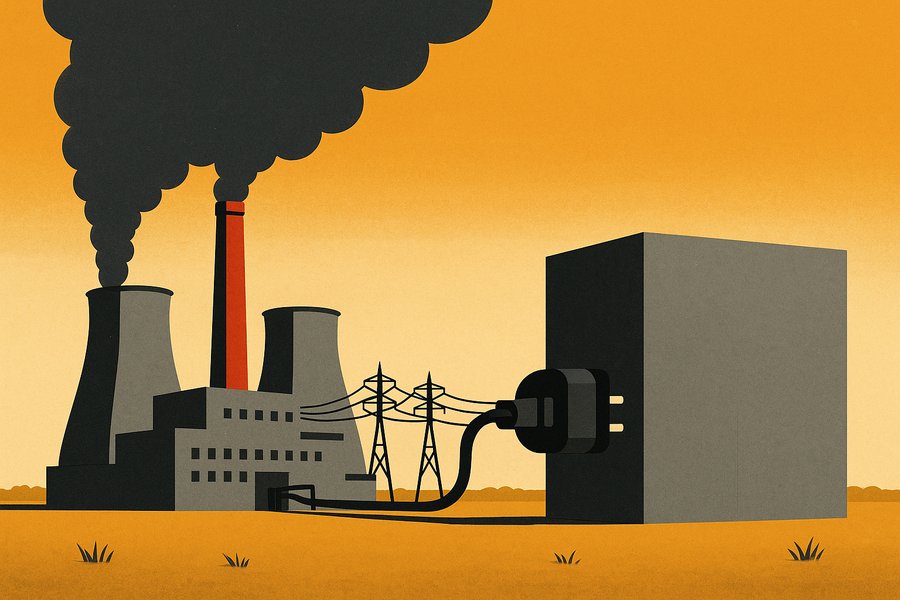
On Monday the US Environmental Protection Agency finalized what its own administrator called "the largest power sector deregulatory action ever," repealing the Biden-era rules that would have forced power plants to slash their carbon emissions or capture them. The timing was almost too neat. The announcement landed days after federal scientists confirmed that the summer of 2026 was the hottest in US history, roughly three degrees Fahrenheit above average. The official justification was blunt to the point of denial, with the EPA declaring that "emissions from power plants have no material impact on global climate change." But the practical force behind the rollback is not really in dispute, and it is not ideological. It is electricity, and specifically the enormous new appetite of artificial intelligence.
The numbers behind that appetite have moved from striking to staggering. Citi now projects that data centers will consume close to 11 percent of all US electricity by 2030, up from about 4.5 percent in 2023. The International Energy Agency expects global data center demand to nearly double, toward 950 terawatt-hours, over the same period. Moody's estimates the US alone needs roughly $110 billion and 45 gigawatts of fresh capacity just to keep pace. And because AI training and inference run around the clock, they reward exactly the kind of steady, always-on generation that solar and wind, on their own, cannot yet guarantee.
That is why fossil fuels, widely written off a few years ago, are suddenly back in fashion. More than 80 percent of announced "behind the meter" power projects serving US data centers rely on natural gas, according to S&P Global. Tom's Hardware, citing Bloomberg figures, notes that American data centers are on track to become the world's fifth-largest natural gas consumer by 2035, burning as much as 15 billion cubic feet a day. The scramble is acute enough that Elon Musk deployed unpermitted gas turbines at his Memphis supercluster, then bought a turbine-leasing company outright to lock in more.
The clean-energy case has not vanished so much as been demoted to a bridge. One sustainability analyst quoted by Fortune described keeping old coal plants alive as a "Band-Aid," a three-to-five-year stopgap to buy time until next-generation nuclear and geothermal can carry the load. Canada is trying to skip the dirty stretch entirely: Bell is planning up to $5 billion of Saskatchewan data centers that must "bring their own power" and use closed-loop cooling to spare municipal water. And in China, which has installed so much solar and wind that it now runs a green-energy surplus, executives are pitching AI as the demand that can finally soak the glut up.
The tension is hard to miss. The same technology that its boosters promise will help solve climate change is, right now, the strongest argument anyone has for keeping the dirtiest plants on the grid. Even if the coal really is a temporary bridge, bridges have a habit of turning permanent when the far bank keeps receding. The EPA framed its decision as a matter of "energy dominance" and of following the letter of the law. Stripped of the politics, it is simpler than that. The machines need power now, more of it than anyone planned for, and someone has to decide what gets burned to supply it.