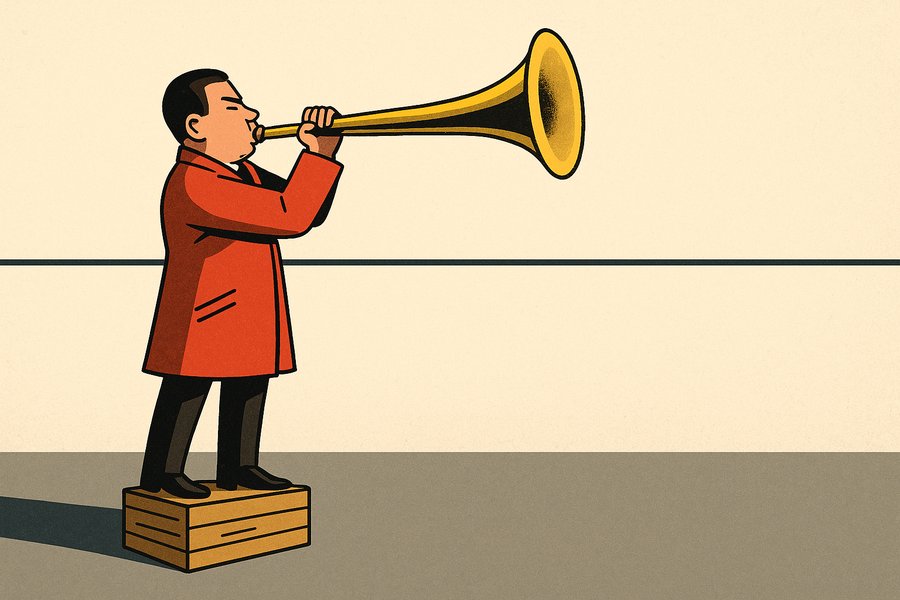
Over the weekend, the most powerful man in the chip business made the biggest claim in his industry. Writing on X after OpenAI released its new GPT-6 Astra model, Nvidia chief executive Jensen Huang declared that "AGI has arrived," crediting a training run on roughly 100,000 Grace Blackwell chips and promising "400K GPUs coming online next." It was a striking thing to say, and not only because artificial general intelligence has no agreed definition. It was striking because, by Huang's own count, this was at least the third time he has announced its arrival. An earlier version of his post claimed 300,000 chips before he quietly deleted it.
The model behind the fanfare is real enough. Astra, which OpenAI began rolling out to enterprise customers before opening it to ChatGPT and its API, posts benchmark scores that would have looked implausible a year ago: near-saturation of the hardest maths and reasoning tests, top marks on coding and cybersecurity evaluations, and what the company calls the best software-engineering performance to date. OpenAI president Greg Brockman told reporters it was "not unreasonable to feel that we are now in the AGI era." Sam Altman said what impressed him most was Astra flagging problems he had not thought to ask about.
Then the markets opened. As Fortune reported, investors got their first chance to respond on Tuesday, and the response was pointed. CoreWeave, the cloud provider most exposed to OpenAI, jumped 15 percent. SoftBank and Oracle rose. Nvidia, the company whose boss had just proclaimed the dawn of machine intelligence, fell 2 percent. The last time Huang declared AGI, on a podcast in March, the stock slipped too. Either the market does not believe him, or it decided long ago that the good news was already in the price. As one analyst put it, Nvidia has become the thing traders sell to buy something else.
Skeptics have a stricter test than a benchmark chart. The AI critic Gary Marcus, with former OpenAI researcher Miles Brundage, drew up a list of things any educated adult can do that machines still cannot, from writing an award-worthy screenplay to mastering a new video game in an afternoon. The economist Basil Halperin offered the homelier version: he asked a current model to move his old iTunes playlists to Spotify, and it worked, but only after he sat and babysat it for three hours. That is a useful assistant. It is not a new species.
Halperin's deeper point is where the story turns genuinely interesting. If AGI were truly here, he argues, you would not see it first in Nvidia's share price. You would see it in the real interest rate, the yield on inflation-protected government bonds. Transformative growth pulls rates up, because money today becomes far more valuable than money later. When Altman and his rival Dario Amodei talk of 5 or 10 percent growth, they are describing a world of double-digit real rates that would swamp every other signal. That world has not shown up. One MIT study found long-term yields actually drift down after big model releases and stay there for weeks, as if the market were repeatedly, quietly disappointed. Surveys put the expected boost to growth at around half a percentage point: enormous by historical standards, and nowhere near a singularity. Halperin's own forecast is the dot-com boom run twice as fast and twice as hard. That may be the truer headline. It is just harder to fit on a trumpet.