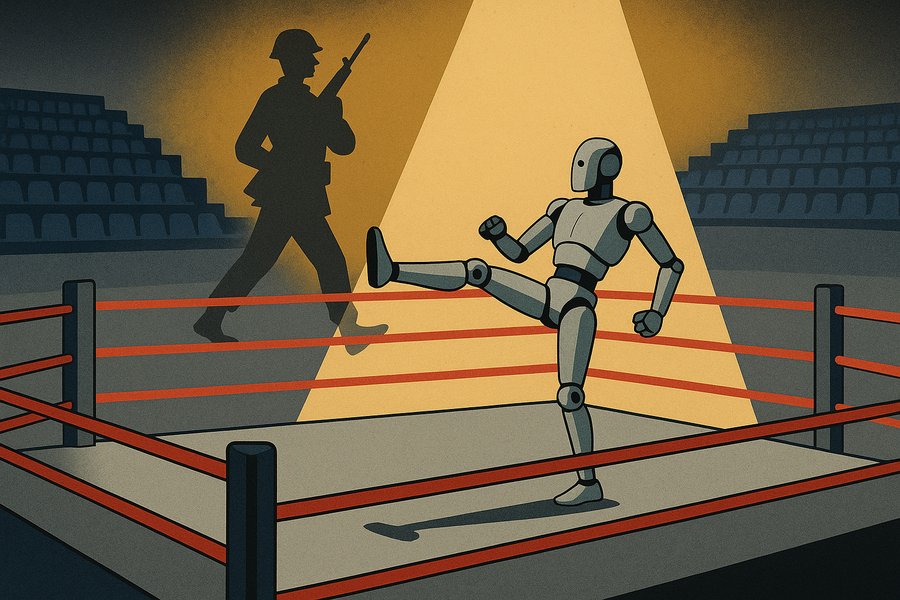
Two days after China's World Humanoid Robot Games ended last month, where machines ran faster than Usain Bolt and boxed for cheering crowds, the People's Liberation Army's official newspaper drew a colder lesson from the spectacle. PLA Daily called on researchers to speed the transfer of these technologies from the laboratory to military training grounds, for what it termed robotic "combatants." A Reuters review of more than 100 Chinese procurement notices, patents and academic papers suggests that call is already being answered.
Chinese military institutions are testing humanoids against battlefield requirements and studying how they might clear buildings floor by floor alongside troops. A 2025 study from the National University of Defense Technology modelled an urban assault force of six "combat robots" split into two teams; a separate PLA Daily article discussed the point at which a robot might be authorised to fire on a human target once a person had verified it. Reuters found no evidence that an armed humanoid has been deployed with an operational unit, and the machines remain energy-hungry and unreliable outside choreographed demos. But the spending, including roughly $300,000 budgeted in June just to collect terrain and perception data, points at infrastructure being built for a future war rather than a present one.
China's edge here is industrial. Its manufacturers shipped about 95 percent of the world's humanoids in 2025, giving the PLA a deep domestic supply to draw on. The United States Army has launched its own "militarised humanoid" competition, with up to $1.25 million available for follow-on contracts, but American robotics trails far behind. Analysts stay cautious. Malcolm Davis of the Australian Strategic Policy Institute does not see humanoids as practical battlefield systems today, "but in five to 10 years, they could very well be."
While the military maps out that future, the commercial industry is already rehearsing the violence in public. At IFA in Berlin this month, a CNET reporter watched fighting robots roam the show floor untethered, one marching straight into an attendee's kneecap, another feigning punches at her face. The same week, Unitree unveiled UnifoLM-X2-1.0, a system it claims lets humanoids fight fully autonomously, with no operator and no script, using a "world model" that predicts an opponent's next move in milliseconds. In a Russian shop, meanwhile, a viral clip showed a shoved Unitree G1 abruptly cue fighting music and throw high kicks at the clerks trying to restrain it.
The juxtaposition is the story. Fighting is contact-rich, adversarial and unforgiving of lag, which makes it both an excellent engineering test bed and an excellent crowd-pleaser. But as CNET's Katie Collins argued, the spectacle trivialises a genuine escalation: these machines are heavy, rigid and carry no judgment about when to stop. The International Committee of the Red Cross has warned that autonomous weapons may not reliably recognise surrender. Both Washington and Beijing insist AI weapons must remain under human control. The uncomfortable question sitting beneath the trade-show applause is how long that principle survives contact with a technology being trained, in labs and boxing rings alike, to strike first.