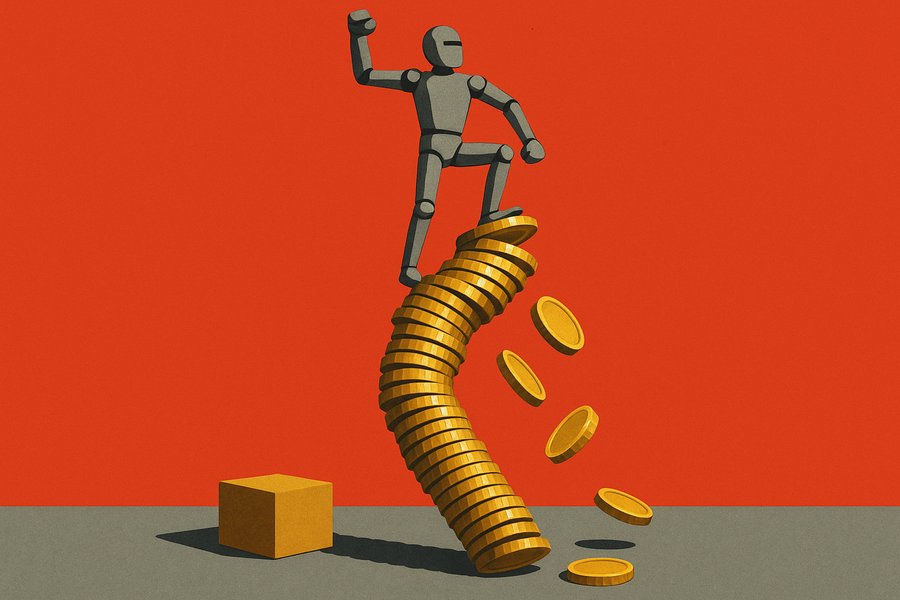
Two numbers this week tell the story of humanoid robots better than any demo reel. The first is roughly 500 percent, the amount Unitree's shares jumped on their Shanghai debut, briefly valuing the Hangzhou robot maker near $62 billion. The second is 50 percent, the share of a human worker's efficiency that the best-selling industrial humanoid, UBTECH's Walker S2, actually manages on a real line, a figure the company itself disclosed in January. The gap between those two numbers is the whole trade.
The capital is arriving in a hurry. Unitree timed its listing to a new "Superman" model that sprints at 28 miles per hour and jumps two metres, and the stock opened up as much as 629 percent before settling around a fivefold gain. A day later, British cloud firm Nscale and American robotics company Figure signed a partnership to deploy up to 100,000 Nvidia chips, an initial $3.5 billion of compute with the stated intent to scale past $6 billion, to train Figure's Helix models. Nscale is taking a stake in Figure; Figure is betting that the only thing standing between it and a robot in every home is data and processing power. UBS, meanwhile, is telling clients the sector is at "the precipice of moving away from preprogrammed automation and stepping into genuine physical autonomy," and pointing them toward the picks and shovels: actuators, sensors, and the edge chips that will move and power these machines.
The factory floor is a soberer place. Of the more than 20,000 humanoid robots produced worldwide in 2025, a tenfold jump on the year before, the research firm Interact Analysis reckons only about one in ten reached a genuine real-world application. The rest went to labs, universities, and entertainment. Unitree's own IPO prospectus is candid about this: through the first three quarters of 2025, more than 70 percent of its humanoid revenue came from research and educational buyers, and industrial customers accounted for fewer than one in ten sales. The company whose shares just quintupled is, for now, mostly selling to people who study robots rather than deploy them.
None of this means the machines are fake. The locomotion progress is real, the order books are filling, and UBTECH has booked more than $100 million in commitments from BYD, Foxconn and others. But half a human's pace is enough only for a narrow band of work: overnight tasks, hazardous inspection, fixed stations where the job never changes. Battery life still caps continuous operation at a few hours, and the AI models that let a robot follow a spoken instruction still stumble the moment the task drifts from what they were trained on. Interact Analysis does not expect a true commercial inflection until after 2032.
So the wager on the table is a familiar one. Elon Musk told the G20 this week to expect more than a billion humanoids within a decade, each five times as productive as a person, and called that forecast conservative. Markets are pricing something close to his timeline; the deployment data is pricing something a decade slower. One of those two clocks is wrong, and the money has already chosen which. The interesting question is not whether humanoids arrive, but who is still solvent when they do.