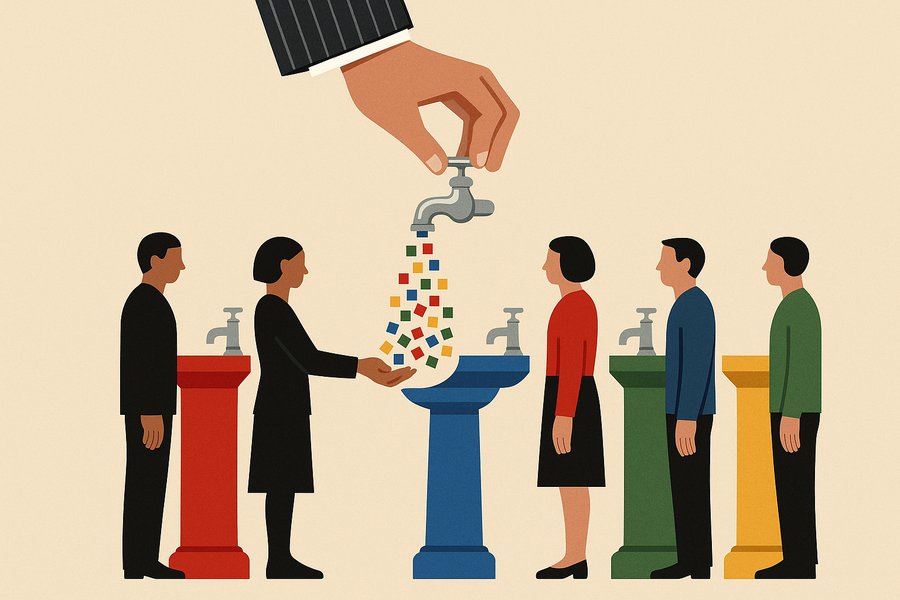
For three years the story of governments and artificial intelligence was a story of rules: what to ban, what to label high-risk, how to fence off the dangerous parts. In the space of two weeks, four governments quietly changed the subject. Thailand, South Korea, the United Kingdom and China each announced a program not to restrain AI but to push it into the hands of citizens or companies. The center of gravity in AI policy has moved from regulation to supply, and the four approaches reveal that "sovereign AI," the phrase everyone now reaches for, means at least four different things.
Thailand went first. On 31 August it opened its TH-AI Passport, giving any citizen aged 15 and over free access to more than 30 commercial models, including Claude, ChatGPT and Gemini, at roughly the paid tier, for a year. More than 1.3 million people registered before launch, against a target of 5 million. The clever part is the budget: the state pays for actual usage rather than a flat fee per head, so an unused account costs nothing. Distribution comes first and regulation follows, since Thailand's own AI law is still out for public comment. That is the exact reverse of the European Union's order of operations.
South Korea is running a similar play with a protectionist twist. Its AI for All plan promises a free assistant to all 51 million citizens with no token cap, backed by 512 Nvidia B200 chips. But operators must build at least 80 percent of the service on Korean models: half their own, another 30 percent from other domestic firms. That is industrial policy dressed as a giveaway, funneling a nation's worth of daily usage into home-grown models that could not win on raw performance alone, so that the training data and operational know-how stay inside the country.
Britain chose to be a customer rather than a distributor. Its £100 million Sovereign AI R&D Procurement scheme buys working solutions from startups for the NHS, defense, cybersecurity and computing efficiency. The reasoning is that subsidies fund research but do not create customers, and a first public deployment is the hardest reference a young company can earn. China, meanwhile, is building the plumbing: a plan to cultivate 3,000 application service providers, the integrators that actually bolt models into business workflows, on the theory that the real bottleneck to adoption is skilled people, not smarter models.
Behind all four sits an uncomfortable set of numbers. The World Bank reckons high-income countries host 87 percent of notable AI models and 91 percent of venture funding while holding 17 percent of the world's population; low-income countries hold less than a tenth of a percent of data-center capacity. Writing in The Express Tribune, one analyst frames the resulting choice for smaller states not as neutrality but as "technological non-alignment," keeping the legal right to switch vendors, models and clouds before dependence hardens into something like surrendered sovereignty. What these four programs share is a bet that whoever controls distribution, not whoever trains the cleverest model, will own the next phase. It is a wager that governments spent the previous three years insisting was the market's to make.