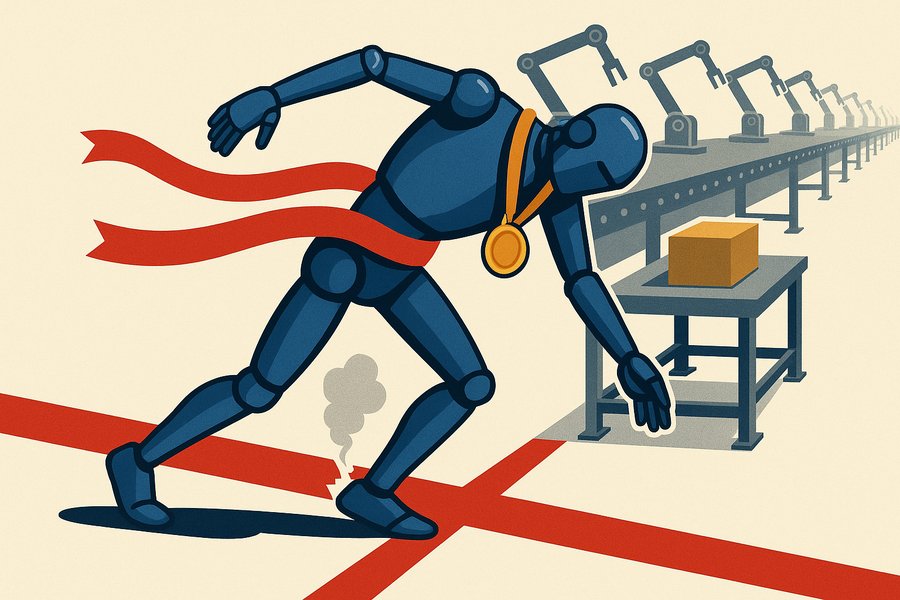
At the second World Humanoid Robot Games in Beijing this month, a machine called Tiangong Ultra ran 100 metres in 9.39 seconds, quicker than Usain Bolt's human world record of 9.58. A second robot beat Bolt too. Then several of them crossed the line and promptly fell over, crashed into padded barriers, or in one widely shared clip burst into sparks and flames. More than 2,000 robots from 16 countries competed across 51 events, and the images that travelled furthest were not the record sprints but the pratfalls. That contrast, between a robot that can outrun the fastest human alive and one that cannot reliably come to a stop, is the most honest summary of where China's humanoid industry actually stands.
The scale of the push is real and it is enormous. China now has more than 150 humanoid companies, more than it has electric-car brands, and its factories run over two million industrial robots, the largest fleet anywhere. Chinese manufacturers built roughly 95 percent of the 20,000 humanoids shipped worldwide last year, and an official says the country expects to make more than 100,000 this year. When Unitree, the world's biggest seller of robot dogs, debuted on the Shanghai market on 19 August, its shares jumped more than fivefold and briefly valued the firm near $50 billion. The hardware is genuinely world-beating: as one robotics official put it, in Shenzhen you can source every component to build a robot in under an hour, a job that takes a week in Europe.
The intelligence is another matter. Inside a government-funded training centre in Guangxi, human trainers wearing headsets guide humanoids through chores like sorting crates and making coffee, and a skilled trainer coaxes out one usable movement in roughly 50 attempts; a novice, one in 300. The robots work at about a fifth of a human's speed. "The robots' IQ is too low," one AI robotics founder told an industry panel. "A lot of what we see is dancing disguised as working." The vision-language-action models that would let a machine handle a messy, unscripted room are far less mature than the chatbots grabbing headlines, and the field has perhaps 500,000 hours of good training data against an estimated 100 million it needs.
What makes this look less like a market and more like a bubble is where the money comes from. Chinese national, provincial and local governments spent at least $230 million buying humanoids and related kit in the first half of the year, up from $62 million a year earlier and just $6 million in early 2024. The state is at once financier, customer and cheerleader, artificially inflating demand for machines that factories, given the choice, still hand to cheaper and more reliable robotic arms. Prices are already sliding: Morgan Stanley expects the average humanoid to get 15 percent cheaper this year, and dancing robots that rented for $1,500 a day now go for a third of that. Founders and investors openly use words like "Hunger Games" and "bubble," and predict a shakeout by 2027.
Yet even a messy consolidation may leave China holding the board. Its component prices are falling so fast that foreign rivals struggle to compete on the parts, so much so that a Chinese gearbox maker like Shuanghuan is now the supplier analysts favour, and Chinese firms are exporting the whole apparatus: Minth Group has opened Europe's first humanoid mass-production line in Serbia, training local staff flown to Zhejiang. The open question is not whether China can build the bodies. It clearly can, at scale and on the cheap. It is whether anyone can give those bodies enough of a brain to justify the spending before the state money, and investor patience, run out.