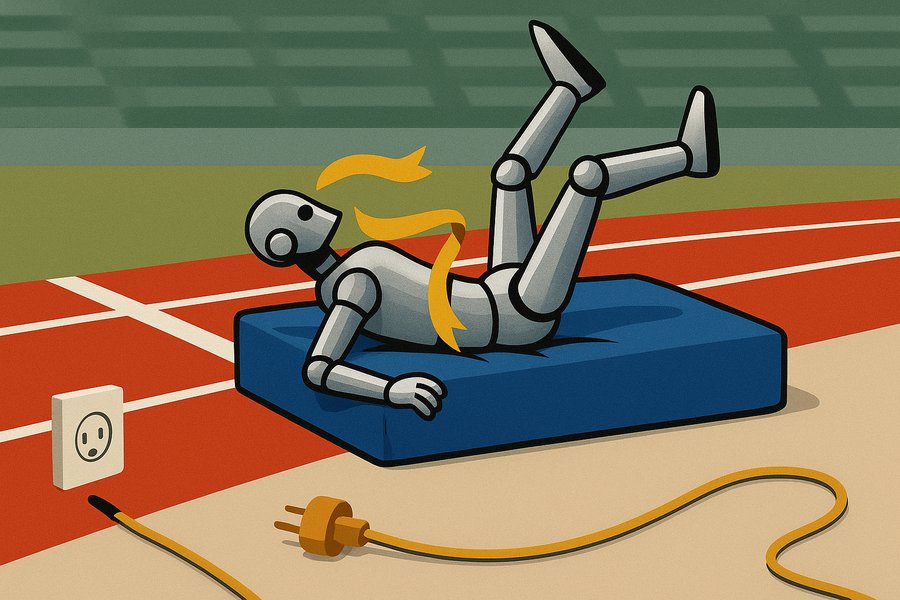
On Saturday, at the second World Humanoid Robot Games in Beijing, a machine ran the 100 metres faster than any human ever has. A robot built by the Beijing firm X-Humanoid covered the distance in 9.39 seconds, shaving nearly two-tenths off Usain Bolt's 9.58-second record from 2009. A rival from the phone maker Honor was clocked at 9.32 in trials. In the high jump, a humanoid cleared 2.88 metres, well past the human record of 2.45. Then, having crossed the line at 23.8 miles per hour with no idea how to stop, the winners slammed into a padded blue wall and were carried off the track on stretchers. Bolt, in 2009, jogged a victory lap.
That single image, a record-breaker being stretchered away because it cannot brake, is the whole story of these Games in miniature. The raw progress is genuine and fast. Last year the same event's winning 100-metre time was 21.50 seconds; this year it is 9.39. The machines roughly doubled their speed in twelve months, a curve no human sport has ever produced. It took people nearly a century to trim the 100-metre record by a little over a second. The robots did far more than that between two summers.
The people who build these machines for a living are the least impressed. Rodney Brooks, the MIT roboticist behind iRobot, dismissed an earlier Beijing race as a "publicity stunt" with "nothing useful that you could use in any application, because it shows no safety at all." Yanran Ding of the University of Michigan named the illusion precisely: we have "a cognitive bias to think that running a half marathon faster than a human is more difficult than folding laundry, which is not true." Sprinting a fixed, flat, known course is one of the easiest things a legged robot can be built to do. The chores are the hard part.
The Games quietly admit as much. Alongside the athletics sit 21 scenario events, and Huawei, a technology partner, says more than 40 percent of the contests require the robots to run fully autonomously. There is an EV-charging challenge, restaurant service, emergency response, industrial assembly, and a cable-connection test that asks a robot to identify an object, position its hands, apply controlled force and recover when something slips. These are the tasks that decide whether a humanoid is a product or a mascot. "Only when it can work in those end scenarios does it have real value," said Yu Chao of Lumos Robotics. "Simply running and jumping does not improve efficiency."
The gap shows in the fine print of autonomy. At a Beijing half marathon in April, only 38 percent of the robots ran without a human pilot, and even those followed a route they had been handed in advance. Alan Fern of Oregon State University puts the sprint gains down to engineering and money rather than any breakthrough, and defines real progress differently: a robot handling a place it has never seen before. That is the bet Europe is making. Germany's NEURA Robotics is building "gyms" to train machines in deliberately messy rooms, and London's Humanoid raised $152 million with Bosch lined up to manufacture, chasing the unglamorous skill of coping with the unexpected.
None of this makes the spectacle pointless. It draws talent, capital and attention: Morgan Stanley pegs the humanoid market at $5 trillion by 2050, and days before the Games the carmaker XPENG raised over $900 million for its own robot line. But a record on a straight track is the easiest number to chase and the least useful to own. The contest that matters is the boring one, in the simulated factory down the hall, where the winner is whichever machine can pick up the cable at the wrong angle and simply plug it in.