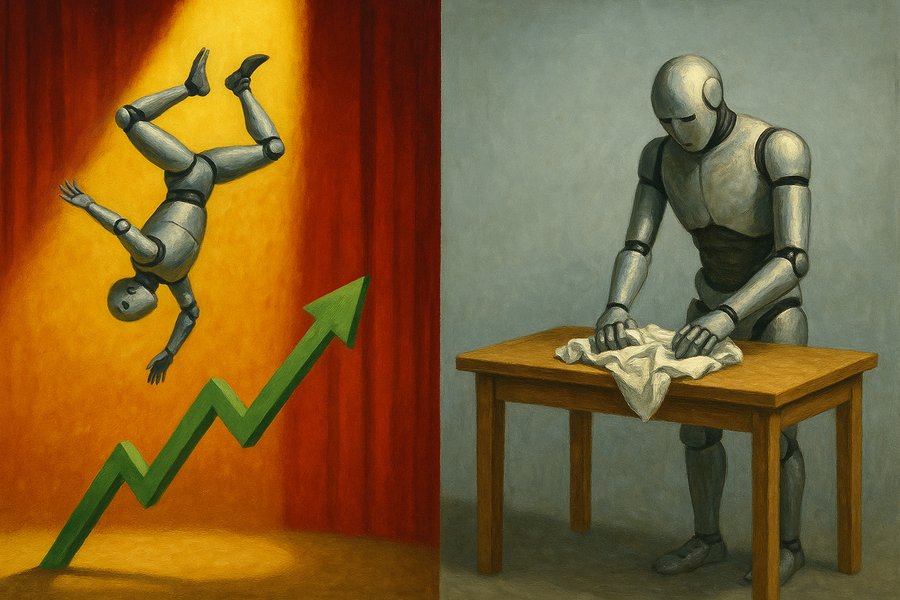
Chinese robotics went public this week in the most spectacular way imaginable. Unitree, the Hangzhou firm whose backflipping, kung-fu-kicking humanoids have gone viral for years, debuted on Shanghai's STAR Market on Wednesday and closed 460 percent above its offer price, having briefly spiked as much as 629 percent. The listing valued the company somewhere between $50 billion and $66 billion, was more than 8,000 times oversubscribed by retail investors, and left founder Wang Xingxing, who owns about a fifth of the business he started in 2016, with a paper fortune north of $12 billion. It was the first humanoid robotics maker ever to list on a mainland Chinese exchange.
The staging was theatrical. Unitree's debut coincided with the World Robot Conference in Beijing, where more than 300 companies showed off over 2,000 exhibits, and it ran days ahead of the second World Humanoid Robot Games, which open on 22 August with 2,056 robots from 666 teams. Machines boxed, danced and played ping pong for the crowds. Days earlier Unitree had unveiled "Superman," a robot it claims can jump two metres from standing and sprint at 12.66 metres per second, faster than the roughly 12.2 metres per second Usain Bolt hit at his 2009 peak.
Then there is the other footage. At the same Beijing conference, a Los Angeles Times reporter watched a helper robot attempt a plain household chore, folding a shirt, and give up after several minutes of failure. Wang himself was strikingly candid on Thursday. The industry's true breakthrough, its "ChatGPT moment," will only arrive when you can drop a robot into an unfamiliar home and have it complete about 80 percent of tasks by voice alone. That is two to three years away if things move fast, he said, or five to ten if they move slowly. A year ago, at the same event, he had put it at under five. Today's robots, he added, must be retrained from scratch for every new task and still fail at "the last few centimetres or millimetres." The inability to generalise is the whole industry's central obstacle.
The money does not yet match the maturity. Most humanoids are still sold to universities and research labs rather than deployed commercially. Unitree is unusual in being profitable, on about $250 million of revenue in 2025 and a 60 percent gross margin, but its products remain largely demonstrations. Analysts keep circling the same question. "The first thing I'm seeking an answer for is how real is the demand," said Omdia's Lian Jye Su, who called the IPO a bellwether for the entire sector. Investors seem to share the doubt: Unitree's stock fell nearly 19 percent the day after its debut.
Layered over all of it is geopolitics. In July the US Federal Communications Commission banned imports of new foreign-made humanoid and quadruped robots on national security grounds, and the Pentagon has added Unitree to its list of Chinese military companies. The United States accounted for about 13 percent of Unitree's revenue last year. Chinese makers shipped an estimated 97 percent of the world's humanoids in the first half of 2026, and Beijing has written robotics into its five-year plan as a growth engine, so the euphoria is national as much as financial, a bet on homegrown champions as the wider economy slows.
What the market bought on Wednesday, in the end, is a wager that the distance between a robot that can outrun Usain Bolt and one that can fold your laundry closes quickly. The man with the most to gain from that bet just told everyone it might take a decade. The spectacle is real. So is the shirt, still lying crumpled on the table.