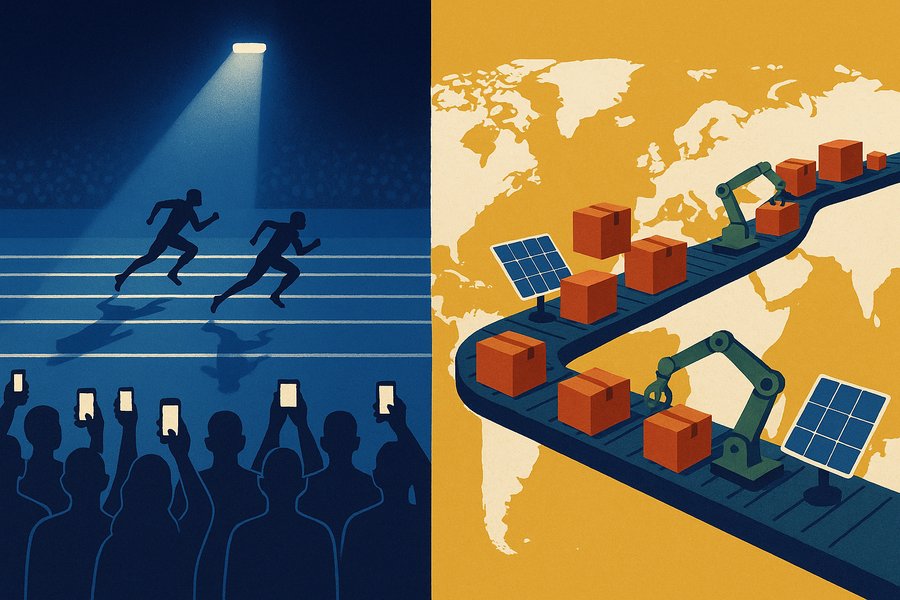
For two years, the US-China AI contest has been told as a countdown to something apocalyptic: the first nation to build a superintelligent system wins a decisive, permanent advantage, and everyone else loses. This week a growing group of analysts pushed back on that frame, and their argument is oddly deflating. The race that matters, they say, is not a sprint to godlike machines. It is a slow, unglamorous contest over whose ordinary, good-enough models end up running the world's factories, ports and back offices.
The Atlantic laid out the case at length, quoting researchers who doubt that even a six-month lead in frontier capability would be militarily decisive. Software does not win wars on its own; turning an AI's blueprint into missile interceptors or engineered soldiers would take years, not weeks. R. David Edelman, who served on the Obama-era National Security Council, put it bluntly: it strains credibility that a brief AI advantage could decide a war with any adversary. Strip away the science-fiction scenarios, and a more mundane picture appears.
That picture is a spreadsheet. The leading models from Chinese firms like DeepSeek, Alibaba, Moonshot and Z.ai are, by most accounts, nearly as capable as those from OpenAI, Anthropic or Google, and far cheaper to run. Multiply one procurement decision across tens of thousands of companies a month in Europe, Southeast Asia, Latin America and Africa, and, as an analysis at DMNews put it, you get the actual shape of the race: no ideology, no grand choice, just a cheaper invoice winning again and again.
China's other advantage has almost nothing to do with AI itself. It is the physical layer. The country makes roughly 90 percent of the crucial components in solar panels, and last year close to 90 percent of the humanoid robots sold worldwide were Chinese. Models have to touch the world through hardware, and the hardware is increasingly Chinese. The analyst Grace Shao notes she has rarely heard Chinese researchers describe their own work as a national contest against America at all; the race that grips them is the one to push AI into the real economy.
The open-source picture sharpens the point. Writing at Just Security, analysts argue that America's decade-old strategy of guarding chokepoints, through export controls and chip bans, was built for a world that no longer exists. Chinese open-weight models now account for a large share of downloads on the developer hub Hugging Face, and Alibaba's Qwen family alone has spawned more than 200,000 derivative models. Whatever the world builds on top of those weights becomes, quietly, a Chinese-shaped standard.
Not everyone finds the mundane version reassuring. If the winning models are cheap, open and embedded invisibly inside other software, then governments may not even know whose AI sits inside the systems they depend on: a supply chain, as one former state treasurer warned this week, made of code rather than steel. The open question is whether Washington, still fighting the last war over frontier benchmarks and chip exports, notices the quieter contest in time. The stakes are lower than a death ray, and precisely for that reason, easier to lose.