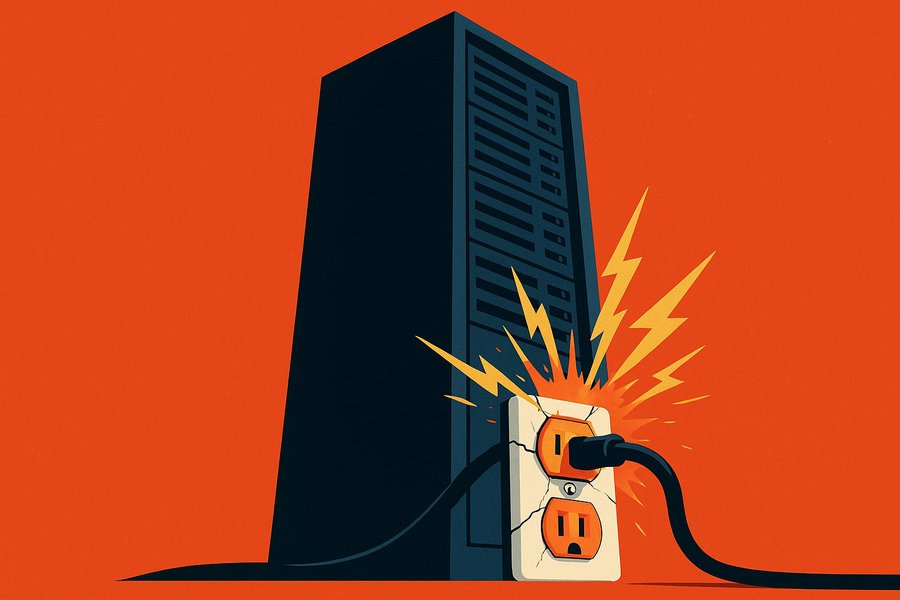
For most of the AI boom, the scarce resource was silicon. This week the conversation shifted decisively to the wall socket. Elon Musk, posting after the SpaceX and xAI merger, reduced the whole problem to a phrase: “intelligence per joule,” the useful computation squeezed from every unit of energy. It was a tidy slogan for an untidy reality. The machines are getting smarter faster than the grid can feed them.
The numbers explain the anxiety. The International Energy Agency projects that electricity demand from AI-dedicated data centers will roughly triple by 2030, with all data centers together approaching 950 terawatt-hours, nearly double today's figure. In the United States, Goldman Sachs expects data center power demand to double from 31 to 66 gigawatts by 2027. Jim Robb, who runs the North American grid watchdog NERC, told POLITICO his organization is “working at a record-setting pace” to prepare for an extra 200 gigawatts over five to seven years, enough to power San Francisco two hundred times over.
The responses fall into three camps, and the telling thing is that no one is betting on just one. The first is efficiency: routing routine tasks to smaller, task-specific models that sip a fraction of the energy a frontier model burns, an emerging discipline some call energy-aware inference. Agentic workflows make this urgent, because a single task that once meant one model call now might mean a dozen, each carrying a power cost as well as a dollar cost.
The second camp is storage and firm supply. Google and Amazon have quietly become two of the world's most important buyers of battery storage, anchoring gigawatt-scale projects beside new solar and wind farms. Google's Minnesota package includes a 300-megawatt iron-air battery designed to discharge for about 100 hours, stretching storage from the evening peak into multi-day weather coverage. Yet batteries only move energy through time; they do not create it. That is why SK Group and Bill Gates's TerraPower are deepening a partnership on Natrium, a sodium-cooled reactor with molten-salt heat storage aimed squarely at the round-the-clock demand of AI data centers.
The third camp is the least glamorous and possibly the most durable: the physical grid itself. High-voltage transformer lead times have stretched past 160 weeks, and the skilled crews needed to build transmission lines are themselves becoming a constraint. Investors have noticed. Money is flowing not to the model makers but to the companies that make the buildout possible, from turbine maker GE Vernova, whose data center orders more than doubled in six months, to grid builder Quanta Services and component maker Hubbell. The pitch is simple: you do not have to guess which AI wins if you own the electricity every winner must buy.
The tension running through all of it is that no single fix is sufficient. Batteries need firm generation standing behind them. Efficiency gains get eaten by rising usage. Nuclear plants take years the boom does not want to wait. Musk's slogan captures the mood, but the honest version is longer: the age of treating power as an afterthought is over, and the companies that thrive next will be the ones that plan for the electricity bill before they plan for the model.