For five months running, artificial intelligence has been the leading reason American employers give for cutting jobs. Challenger, Gray & Christmas counted 10,970 AI-linked layoffs in July alone, and employers have now attributed more than 100,000 planned cuts to the technology so far in 2026. It reads like the employment apocalypse that forecasters spent three years warning about. Yet the more carefully anyone looks at the underlying data, the more the story changes shape. The machines are not, for the most part, marching workers out of the building. They are doing something quieter, and in some ways harder to fight: holding down pay and drying up the next round of hiring.
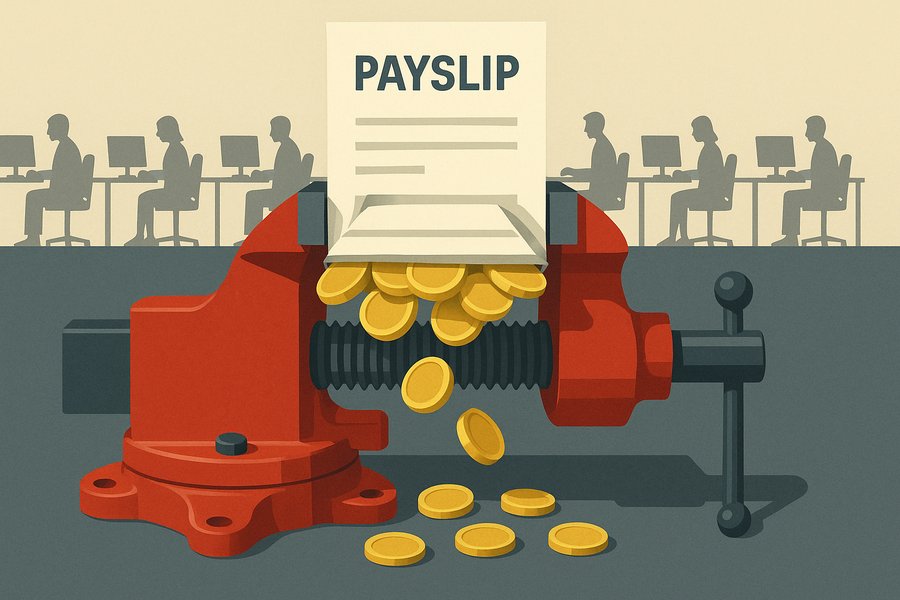
The most striking evidence comes from an unusual source. The asset manager Apollo analysed enterprise usage data from Anthropic, one of the largest AI labs, through the end of 2025, and found “no detectable employment effects” from the technology. What it did find was a 6.7 percent decline in real wage growth for workers in the occupations most exposed to AI. The report's blunt conclusion was that employers are “capturing AI productivity gains through wage compression rather than workforce reduction.” Rather than firing people and booking the savings, companies are keeping staff on and quietly letting their pay fall behind inflation.
The pain is not evenly shared. Apollo found the wage effect concentrated at the bottom of the ladder: a 24.3 percent hit to real wage growth for service workers, and 10.7 percent for the lowest-earning quartile, while top earners showed no measurable effect at all. Customer service reps, travel agents, administrative clerks and telemarketers sit squarely in the blast radius. By this reckoning more than five million American workers, roughly 3.7 percent of the labour force, are already living with AI-related declines in real income, even as the promised wave of mass unemployment fails to arrive.
Elsewhere the same force shows up as jobs that simply never open. In Nigeria, where analysts warn that nine million routine roles could disappear by 2030, one executive calls it “quiet displacement”: companies automate a task first and adjust headcount later, so the first casualty is not the worker who is let go but the graduate who is never hired. In China, programmers who once rode the punishing “996” culture into the middle class are being pushed out in their thirties and forties as AI coding tools let fewer engineers do more. One 45-year-old had spent 22 years at Alibaba before being dismissed. The ladder is being pulled up from the bottom rung.
All of which raises an awkward question: if the damage is turning up in wages and vacancies rather than pink slips, how would anyone officially know? New York is about to try to find out. A bill passed by both chambers in June would require many employers to report each year on how AI affected their workforce, building on a state rule that already asks companies filing layoff notices whether AI played a part. So far the data is thin to the point of absurdity: exactly one 2026 filing names AI, a Nespresso action affecting 46 workers, logged as “Relocation of Business, Artificial Intelligence,” with no way to tell how much was which. That single ambiguous line is a fair summary of the whole debate. The effect is real, it is spreading, and it is stubbornly hard to see.