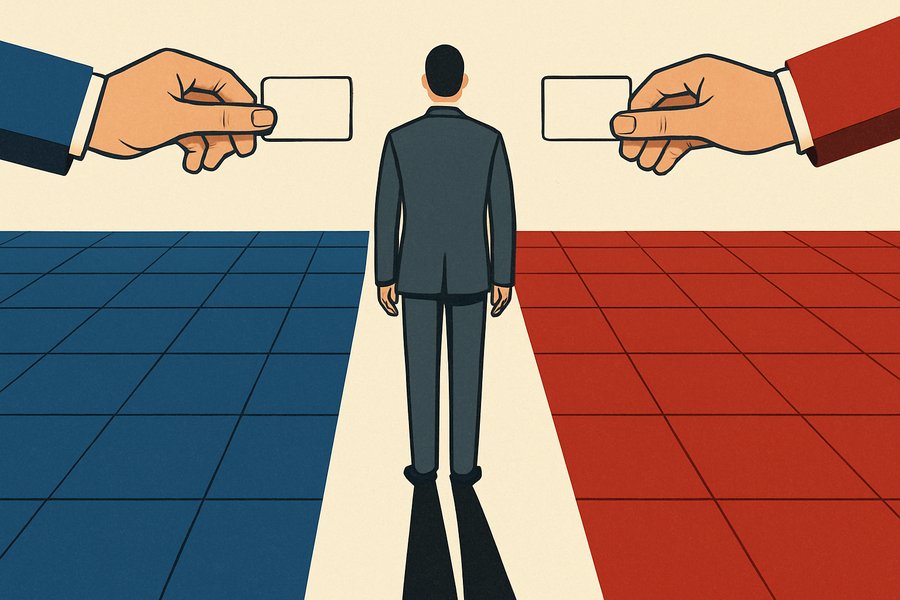
Diplomatic letters are usually written to keep options open. The draft that Reuters reviewed this week does the opposite. In it, the US State Department tells 35 countries that when it comes to artificial intelligence, they must choose. “To be part of everything is to be part of nothing,” the text reads. Signing Washington’s AI declaration is “not merely a membership subscription, but a commitment,” and it “cannot be held alongside membership in duplicative initiatives whose expectations conflict with our own.” The document never names China. It does not have to.
The initiative at the center of this is Pax Silica, which Washington launched last year to lock down supply chains for three things at once: AI models, the semiconductors that run them, and the critical minerals that go into the chips. About two dozen countries have joined, among them Japan, Australia, and South Korea. The wider group of 35, the recipients of the letter, signed a looser “AI Opportunity Statement” in June that committed them to little more than a shared vision. The letter is an attempt to turn that symbolism into a binding choice, and to starve Beijing of partners in the race to build the most advanced systems.
What tipped a non-binding framework into an ultimatum appears to be a single country. Kazakhstan joined Pax Silica in June, celebrated by Washington as the first Central Asian member and a significant source of the minerals advanced chips depend on. Then it also joined China’s competing bloc, the World Artificial Intelligence Cooperation Organization, which President Xi Jinping launched in July to promote Chinese open-weight technology as an alternative to American influence. Kazakhstan is so far the only country known to have signed up for both, and that hedging set off alarm bells in Washington.
The interesting tension is that forcing a choice may be exactly the wrong move. Analysts at Citi Research argue that a full US-China AI decoupling would be “manageable” for trade, since direct AI commerce between the two is already heavily suppressed; even an extreme rupture would put around nine percent of China’s exports at risk. But they flag one genuine wild card: restrictions on open-weight models, the freely downloadable systems Chinese labs have been shipping aggressively. Cut off access there, and the effects are far harder to predict, because those models spread through developers rather than through customs.
Chinese commentators, meanwhile, are warning their own side against the same trap. Analysts quoted by the South China Morning Post caution that if Beijing’s new organization is seen as “naturally opposed” to the United States, it will scare off the very countries it hopes to attract. The fear on both sides is identical and mutually reinforcing: that the world’s AI landscape hardens into two walled camps, and that everyone else gets pushed to the fence and told to jump.
That is the real stake buried in the phrase “choose deliberately.” For a country like Kazakhstan, sitting on minerals both superpowers want, neutrality has been the whole strategy. The American letter is a bet that access to US models, chips, and investment is worth more than the freedom to keep a foot in each door. Whether that bet pays off depends on a question Washington cannot answer alone: when the technology itself is increasingly open and copyable, how much leverage does exclusion really buy?