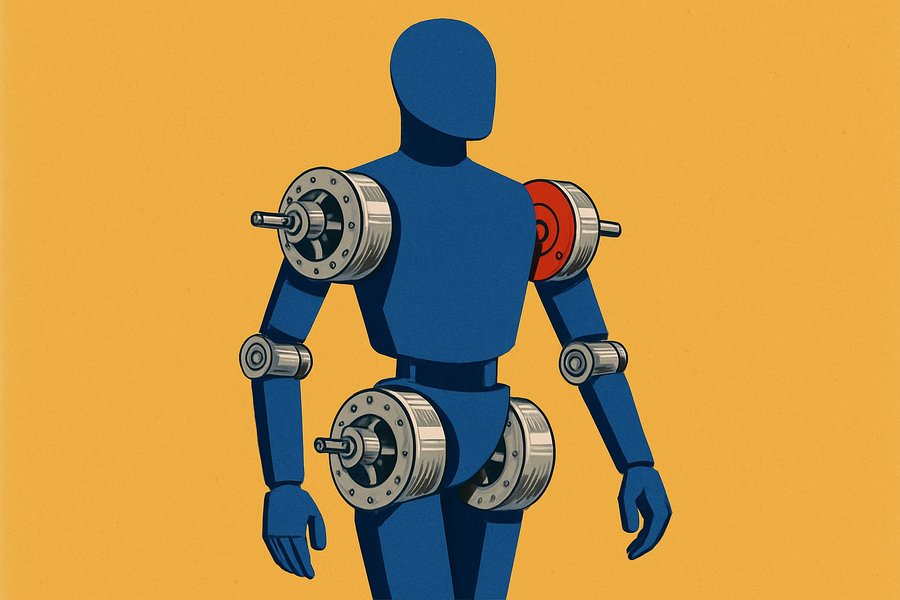
Ask what makes a humanoid robot expensive and the answer is not the brain, it is the joints. The motorised actuators that let a robot bend an arm or take a step account for somewhere between 30 and 60 percent of the entire bill of materials, depending on the design, and startups buy them from specialist suppliers at 500 to 2,000 dollars apiece. Which is why a quiet piece of Korean reporting this week matters more than it first appears. Samsung, it turns out, has been secretly building a humanoid robot whose most costly component is essentially a washing-machine motor.
The scoop, from South Korea's ZDNet Korea and Maeil Business Newspaper, is that Samsung has run an in-house humanoid program for years, entirely separate from the two robotics efforts it has announced in public: the Robotics eXperience division it launched on 21 July, and Rainbow Robotics, the specialist firm it took a controlling stake in last year. The confidential project is reportedly at an advanced stage and, according to industry sources, already outperforms Samsung's domestic rivals. The public announcements, in other words, were the visible part of a larger and better-hidden bet.
What makes the bet distinctive is where Samsung starts. The company stamps out brushless DC motors by the million for washing machines, air conditioners and refrigerators, and those motors share their fundamental engineering with a robot's joint actuators: the same windings, the same permanent magnets, the same rotor balancing and control electronics. Adapting an appliance line to build robot actuators is far cheaper than tooling one up from scratch, because the factory, the supply chain and the quality control already exist and are paid for. If the single priciest part of a humanoid is a fancy motor, the firm that already makes the world's motors cheaply is holding a card nobody else has dealt.
The software is not an afterthought. Samsung Research has published Shallow-Pi, a vision-language-action model that fuses what a robot sees with how it moves, running at roughly a third of the compute a conventional system needs and making 17 decisions a second. In factory tests it hit a 95 percent success rate on a sub-millimetre task, inserting a water hose while coordinating 22 joints across two arms. The company is also building a "Robot Data Factory" at its Gumi campus, where robots working real semiconductor, smartphone and appliance lines generate the scarce, high-quality training data that simulations cannot. The factory is the flywheel: more robots on real lines means more data, which means better robots.
This reframes a race that is usually told as two stories. America leads on AI software; China leads on cheap, high-volume manufacturing, shipping the great majority of the world's humanoids. Samsung is running a third playbook, pairing a serious AI stack with the cost structure of a consumer-electronics giant, and it has the balance sheet to force the issue. The broader group has earmarked something like 60 trillion won, roughly 42 billion dollars, across batteries, chips and factories, with chairman Lee Jae-yong presenting robotics as a national priority alongside the Korean government.
Caveats belong here. Samsung has not confirmed the program exists, "outperforms rivals" is an anonymous claim rather than a demonstrated benchmark, and a promising actuator is not a shipped product. But the strategic logic is hard to unsee. Unitree already sells a full humanoid for around 16,000 dollars by driving down exactly this component cost through China's supply chain. Samsung's wager is that it can match that price at Western engineering quality, using an advantage it built decades ago while making household appliances. The most interesting robot of the year may be the one the company will not admit to owning.