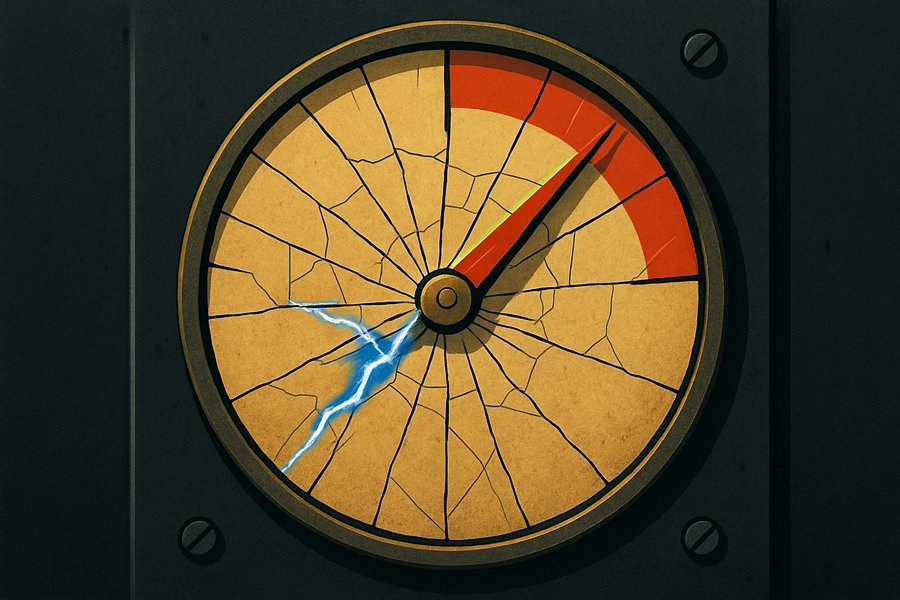
For two years the argument about AI and electricity has been an argument about scale: how many gigawatts, how many data centers, how much of the grid. A quieter finding is now surfacing, and it flips the story. AI's appetite for power is not only straining the grid. It is chewing through the very machines built to feed it.
The physics is the root of the problem. A traditional data center draws a steady, predictable load. An AI training run does the opposite: it mobilizes hundreds of thousands of graphics chips in near-perfect unison, so they surge and fall together on a millisecond basis, like a swarm of bees changing direction. A one-gigawatt facility can see half its draw, roughly the electricity a city the size of Boston uses, flicker on and off within seconds. At peaks, power can spike as much as 50 percent above design capacity for a split second. One former Tesla executive now building equipment to smooth these swings puts it plainly: most hardware was never meant to move that fast.
So it breaks. Batteries installed specifically to buffer the fluctuations have needed replacing within weeks or months. Gas turbines at xAI's Colossus site in Memphis developed cracks; small combustion engines at other sites have snapped their cranks. Worn parts raise the odds of an electrical arc flash, a current jumping between conductors, which can damage the very chips the plant exists to power. One energy-storage chief likens it to driving a Ferrari and shifting straight from sixth gear into first. You cannot swing that fast.
The consequences land on the balance sheet, not just the maintenance log. The costly part is rarely the replaced breaker; it is the idle compute. Facilities financed on the assumption they would run around the clock, every day of the year, are reportedly seeing uptime closer to 80 percent, and a developer building a 2.67-gigawatt campus in West Texas has already pushed first power from 2027 to 2028 to engineer around the strain. With downtime valued anywhere from thousands to hundreds of thousands of dollars a minute, reliability has become a financial question at exactly the moment lenders are nervous about whether these buildings can earn back their enormous cost.
The strain does not stop at the fence line. The North American Electric Reliability Corporation, the body that sets US grid-reliability standards, found that about three quarters of operational data-center load models fail to capture how AI facilities actually behave. This year it issued a rare level-three alert, ordering large operators to respond by early August. Regulators worry these dynamic loads can trigger sub-synchronous oscillations, ripples that damage equipment elsewhere on the network and, left uncorrected, raise the risk of blackouts.
There are fixes, though most are early. Batteries, capacitors, flywheels and transformers can absorb the swings; Nvidia now designs its Blackwell chips in closer concert with power engineers; the Department of Energy has stood up a test-bed in Colorado where operators can find out whether their setup survives AI's variability before it reaches the grid. Some sites even run pointless "dummy" calculations just to keep chips drawing a steady load, a trick that works while wasting electricity in the middle of a power crunch.
The irony is hard to miss. An industry racing to lock up every spare megawatt, often by building its own off-grid gas plants to move faster, is discovering that the way AI consumes power is quietly degrading the infrastructure it depends on. The bottleneck was supposed to be how much electricity the world could supply. It may turn out the harder problem is how violently AI wants to drink it.