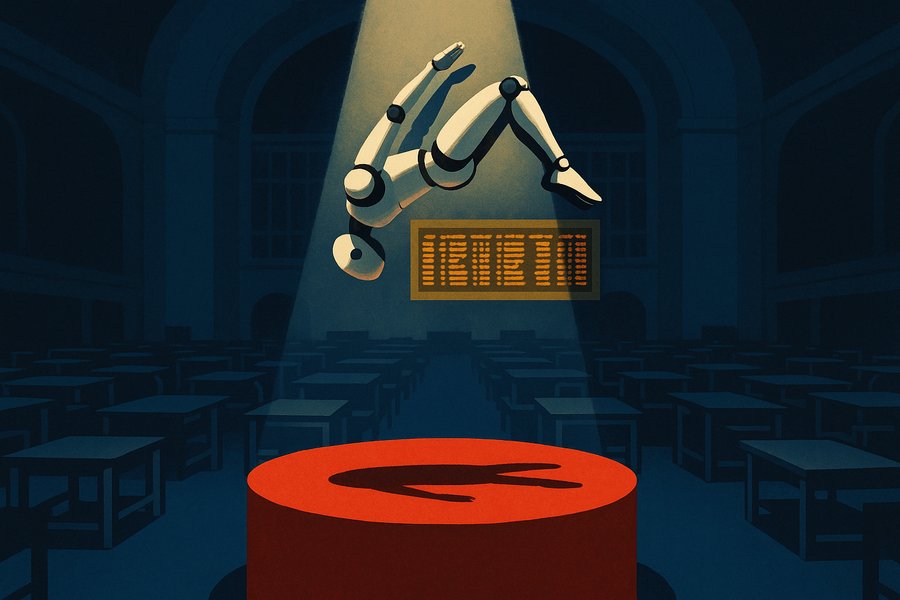
Unitree, the Chinese company whose robot dogs and backflipping humanoids have racked up hundreds of millions of views online, is about to become something more prosaic: a listed stock. This week it priced its initial public offering on the Shanghai Stock Exchange at 150.8 yuan a share, aiming to raise around 6.1 billion yuan, or roughly $900 million, at a valuation near $9 billion. That makes it the first humanoid robot maker to list on mainland China's market, and it turns a viral novelty into a test that financial markets, not video feeds, will grade.
Unlike most of its rivals, Unitree is already a real business. Founded in 2016 by engineer Wang Xingxing, the Hangzhou company more than quadrupled its revenue in 2025, to nearly 1.7 billion yuan, about $250 million, and, unusually for the sector, turned a profit. It shipped more humanoids last year than any other manufacturer, and more than 40 percent of its sales came from abroad. The catch surfaced in the first quarter of 2026, when profit fell 55 percent as competitors piled in and research spending climbed. Growth, the company said, had slowed.
The bet investors are being asked to make is not really about today's numbers. It is about a market that does not exist yet. Analysts at CLSA think the global humanoid market could reach $69 billion by 2030, up from about $2 billion now, and Morgan Stanley has floated $5 trillion by 2050. Against those forecasts, the installed base is tiny. Worldwide, the number of humanoids doing genuinely productive, autonomous work still runs only to the hundreds or low thousands.
What China has, and what the listing is really selling, is manufacturing. Omdia estimates Chinese firms shipped about 18,500 humanoids in the first half of this year, against roughly 4,000 from American companies. Unitree sells a full-size machine for around $16,000, and one model has appeared under $6,000, prices underwritten by a supply chain for motors, sensors and batteries that would cost several times as much to rebuild elsewhere. US firms such as Figure, Agility, Tesla and Apptronik, powered by Nvidia's chips, still lead on the hardest AI; China leads on price and volume.
The approach showing up on factory floors and in lobbies is what one outlet called "good enough." A robot does not need to pass for human, it just has to clear one narrow bar. UBTech's Walker S2, which can swap its own battery in about three minutes, now works a China-Vietnam border crossing under a $37 million government contract, guiding travelers and inspecting cargo. BYD wants two or three humanoids in every showroom. Yet much of the demand still comes from universities and government projects rather than from paying households or factories.
That is the question the Shanghai listing forces into the open. A robot doing kung fu proves the machine is impressive; it does not prove anyone needs to buy one. Unitree's profit already wobbled the moment competition arrived, and rivals Leju and AgiBot are lining up listings of their own. If investors endorse the $9 billion price, they are wagering that cheap, "good enough" robots can manufacture their own demand before the money runs out. The technology is clearly viable. Whether it is a business is what the market is now being asked to decide.