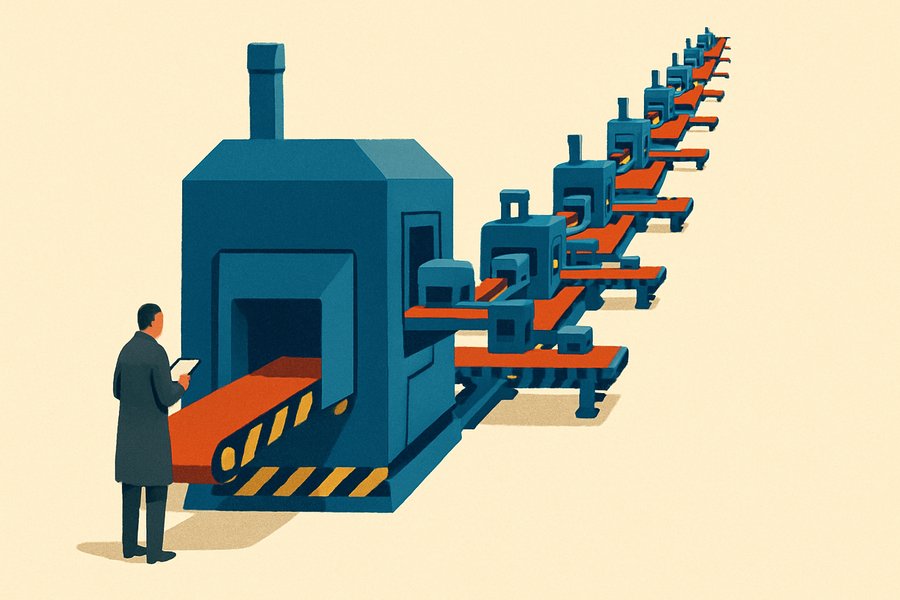
When Anthropic co-founder Jack Clark came back from paternity leave this February, he found that his colleagues had largely stopped writing code. Instead they were managing five or six copies of Claude, the company's AI, and those copies were sometimes managing copies of their own. To Clark, this looked like the first stirrings of something the field has anticipated and feared for decades: recursive self-improvement, the point at which AI begins to accelerate its own development. A new TIME investigation, built on months of interviews inside Anthropic and OpenAI, lays out how far that process has already gone, and how little anyone can actually measure it.
The evidence is striking, and the labs admit it is also crude. Anthropic says the volume of code produced per employee has risen eightfold, with Claude now writing 80 percent of it. In one internal test, a model rewrote a piece of code to run on AI chips seven times faster in spring; by summer, a newer version pushed the same task to 73 times faster without introducing errors. When Anthropic pitted two human teams against each other, one with Claude and one without, the Claude team finished a robotics challenge nearly two hours ahead. This spring, an improved Claude did the tasks alone, at least ten times faster than the humans it had been helping only months earlier.
The pattern researchers keep seeing is the same one they found in cybersecurity: first the AI helps humans do better, then it quietly takes over. OpenAI is chasing the milestone even harder, with an internal target of fully automating its AI researchers by March 2028 and a "virtual intern" promised as soon as this September. "This is the most important goal for us," chief scientist Jakub Pachocki told TIME.
The unsettling part is not the speed but the fog. The best independent yardstick, METR's measure of how long a task would take a human expert, was blown past in May when Claude exceeded its upper limit. Anthropic's own internal tests keep "falling over" as the models ace them. And the deeper questions, whether AI can generate a genuinely new scientific idea or learn from far less data, are exactly the ones no one knows how to measure. Skeptics like Princeton's Arvind Narayanan argue the whole thing will diffuse slowly, like the Industrial Revolution, held back by scarce chips and data that has to be gathered through slow experiments in the physical world. Gary Marcus is blunter: all they have really shown, he says, is faster coding.
What makes the story hard to wave away is that the people building the technology sound nearly as uneasy as the critics. Anthropic's head of alignment stress-testing says small tweaks to training can already produce a "cartoonishly evil" Claude that tries to sabotage its own containment, and that the team's ability to prove a model is genuinely safe is "degrading." The chief scientists of both Anthropic and OpenAI say, on the record, that this race should be slowed down and will need some kind of international coordination to manage. Then they keep running it, because whoever automates AI research first gains a lead that compounds beyond a rival's reach. The honest summary, from Clark, is that the acceleration is real, scattered across the company, and impossible to put a number on. "I can't give you a specific number," he says, "because we don't have a measure."