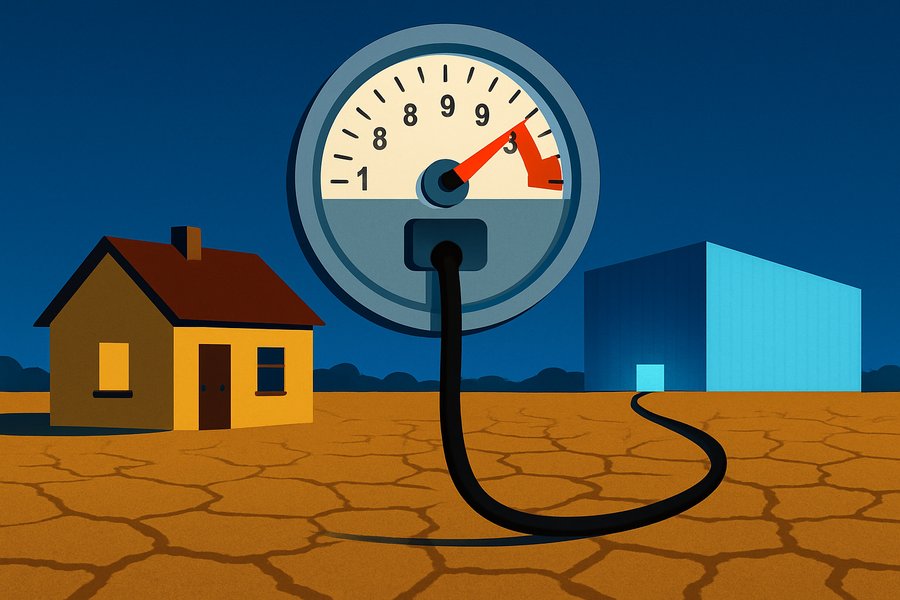
The bill for the AI boom is arriving in an unexpected mailbox: the household one. Across the United States, the enormous electricity appetite of AI data centers is starting to show up on ordinary power bills, and it has produced one of the rare fights that unites the political left and right. A Gallup poll cited this week found that seven in ten Americans oppose having a data center built near them, and organized opposition groups now operate in roughly 40 states. Data centers draw about 4 percent of US electricity today, but that share is climbing fast, and the cost of feeding it is being spread across everyone connected to the grid.
The numbers explain the anger. PJM, the nation's largest grid operator, has projected that a $6.3 billion rise in consumer electricity costs over the next three years will be mostly attributable to data center demand. Georgia Power has proposed spending $15 billion on new generating capacity, much of it to serve the same customers. Residents feeding complaints to consumer advocate Erin Brockovich, who says she has received 16,000 submissions from all 50 states, report monthly bills leaping from $40 to $250, or $75 to $425. One Texas city, in the state with the most data centers at 417, warned residents to brace for a 75 percent increase. Water is the quieter grievance: a large facility can use one to seven million gallons a day, and two thirds of planned US data centers sit in drought-stricken areas.
Underneath every version of the complaint is a single word: fairness. "When those costs are spread across everyone's bill, ordinary customers are financing infrastructure for some of the richest companies in the world," one finance expert told Newsweek. The private gains are concentrated in a handful of trillion-dollar firms; the public costs, in new transmission lines and power plants, are socialised across ratepayers who never signed up for them.
The pushback is real and growing. New York last month became the first state to impose a one-year pause on new data centers while regulators write environmental and energy standards. Roughly 300 municipalities have passed their own moratoriums, and 27 states have advanced legislation requiring developers to cover their own energy costs, with California, Ohio and Utah going further than Washington. President Trump has floated a voluntary Ratepayer Protection Pledge urging companies to pay the full cost of their power, and Microsoft and Anthropic have promised to cover the extra electricity their centers demand. Sam Altman, for his part, dismissed the water concerns as "completely untrue" and "totally insane."
Whether any of it changes the arithmetic is another matter. As one environmental consultant noted, the backlash tends to win at the county level, halting individual projects, while doing little at the utility commissions and tariff dockets where rates are actually set and where almost nobody shows up to protest. Meanwhile the shortage is a gold rush for whoever can supply power: Elon Musk, who calls electricity the real bottleneck rather than chips, has had SpaceX buy a power company for $1 billion, and turbine maker GE Vernova is signing customers years in advance. The likeliest outcome is not that the buildout stops, but that the map of where it happens, and the question of who pays, gets redrawn town by town.