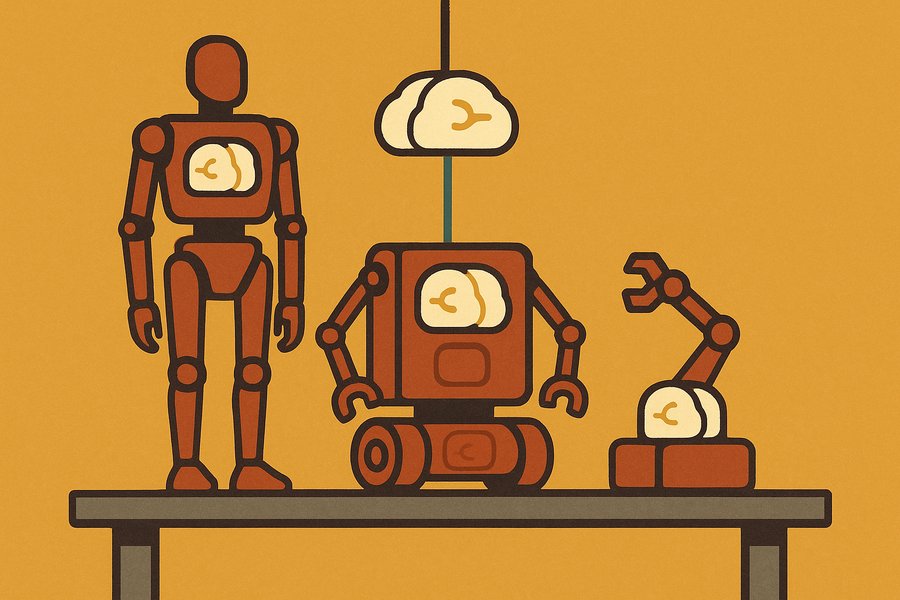
On 30 July, Google DeepMind did something quietly radical: it took one AI model and used it to drive three physically different robots. The same software checkpoint controlled an Apptronik Apollo 2 fitted with two separate sets of hands, and a two-armed rig with simple grippers it was never designed for. That demonstration is the point of Gemini Robotics 2, DeepMind's new suite of models. The company is not really selling a cleverer machine. It is selling the idea of a single brain that any robot maker can pour into any body, and it wants to be the one that supplies it.
The release comes in three parts. Gemini Robotics 2 is a vision-language-action model that turns what a robot sees and is told directly into motion, from feet to fingertips. Gemini Robotics ER 2 is the reasoning layer, planning multi-step jobs over several minutes, catching its own failures, and splitting work between more than one robot. Gemini Robotics On-Device 2 is a stripped-down version that runs on the hardware itself and can adapt to an unfamiliar machine with fewer than 200 examples and a few hours of data. Unlike the 2025 version, which only handled a robot's upper body for tabletop tasks, this one governs the whole frame at once, so a humanoid can walk, crouch, bend and reach in a single fluid motion rather than stopping to think between each step.
What makes the release unusual is how candid DeepMind is about the gaps. In its own tests, the Apollo 2 picked objects off a table 68 percent of the time and off a shelf 76 percent of the time, but managed the floor, the task that leans hardest on full-body control, only 46 percent of the time. The fancy five-fingered hands were more revealing still: 92 percent success unscrewing a lightbulb, but just 36 percent screwing one back in, 44 percent tying a rubbish bag, and 40 percent sealing a zip-lock bag. Plain two-finger grippers quietly outperformed the elaborate hands on most jobs. The message beneath the demo reel is honest: the last few centimetres of dexterity are nowhere near solved.
So why does this matter beyond a research lab? Because of what DeepMind is pitching. It calls Gemini Robotics 2 an "intelligence layer," the foundational system every hardware maker builds on top of, and the industry has an obvious analogy in mind. If humanoid machines ever become as common as laptops, whoever supplies the universal brain that transfers cleanly from one body to the next collects a toll on the entire industry, exactly the way Android and iOS did for phones. Alphabet is not alone in seeing this. Nvidia's open GR00T models, Figure's Helix, Physical Intelligence and a wave of Chinese labs are all chasing the same prize: not a single winning robot, but the software that runs all of them.
There is a caution worth keeping. This is a gated research preview with a waitlist, not a product; the action models are limited to a hundred-odd trusted testers, and nobody is putting them to work on a warehouse floor next quarter. DeepMind also says ER 2 is its safest robotics model yet, tested on whether a robot will refuse an unsafe instruction and defer to a human. The tension that will define the next year is plain enough. The brain is finally learning to move a whole body, and yet a robot trying to screw in a lightbulb still fails six times out of ten. Owning the intelligence layer may prove enormously valuable long before the machines it runs are actually reliable.