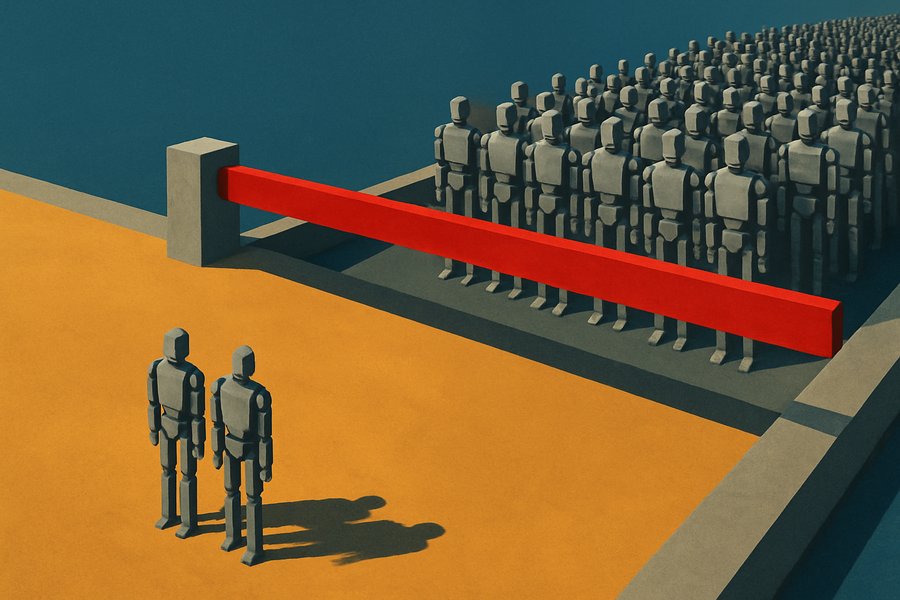
On Tuesday the Federal Communications Commission quietly redrew the map of the robot business. It added foreign-made humanoid robots and their four-legged cousins, the robot dogs, to its Covered List, the roster of gear deemed too risky to authorise for sale in the United States. Almost every electronic device needs FCC authorisation before it can be imported or marketed, so the practical effect is blunt: new foreign robots now have essentially no way into the American market. The order also swept in networked power inverters, the humble boxes that route electricity through solar arrays, batteries and data centres.
The FCC's fact sheet names no country, but the market math points in one direction. China supplies roughly 85 to 90 percent of the world's humanoid robots. Of the 15,000 or so shipped globally last year, the Chinese firms Unitree and Agibot each sent out more than 5,000; American rivals such as Tesla and Figure managed a few hundred at most. Six of the world's ten leading humanoid makers are Chinese. In one move, Washington has cut the market leaders off from the richest market on the planet.
The stated reason is national security. A White House-convened interagency body concluded that internet-connected robots could collect data to surveil Americans, aid foreign intelligence services, or be remotely commandeered, and that dependence on foreign hardware leaves supply chains exposed. It is the same logic used earlier against Chinese drones, electric vehicles and routers. What stands out is how physical the worry has become: this is not about a chatbot leaking text, but about a machine with arms and legs standing inside a home or a factory.
It is worth being precise about what the order does and does not do. It is a forward-looking gate, not a recall. Robots already authorised can keep selling; devices Americans already own are untouched. There is a conditional-approval path, with robot applications judged by the Department of War and inverters by Homeland Security, and the federal government exempts itself entirely. So the ban bites hardest on tomorrow's models, which is precisely the point, because in a field moving this fast, being frozen at today's hardware is close to being locked out for good.
The timing is delicate. The bans land weeks before President Trump is due to host Xi Jinping in September, and Beijing responded fast, accusing Washington of "unilateral bullying" and protectionism and threatening countermeasures, with rare-earth exports and market access for Tesla and Nvidia the obvious levers. Analysts are cooler. Omdia's Lian Jye Su expects the hit to Chinese makers to be "minimal," noting many are already pivoting to Europe, where Unitree began selling on 22 July. The clearer winners are American: Tesla, Figure, Boston Dynamics, Agility and a field of some 180 startups sitting on roughly $150 billion in funding.
Which is where the awkward question sits. A protected market lets young American robot makers grow, but it also shelters them from the very competition that has driven China's costs down and its shipments up. The United States has banned the robots it cannot yet build at scale, betting that a walled garden will help it catch up. The history of protected industries suggests that gardens can just as easily grow slow.