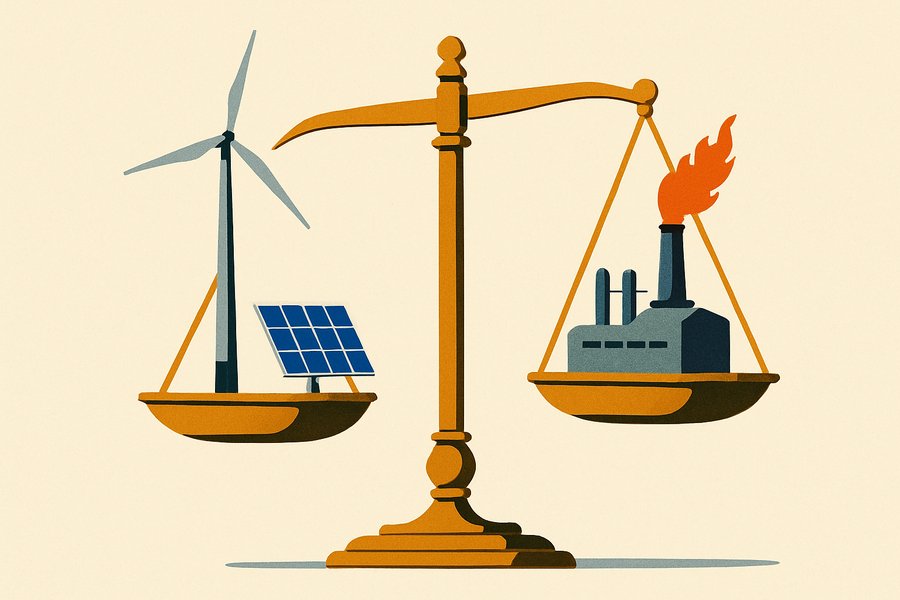
Meta has spent more than a decade telling the world it would run on clean power. Late last week, quietly, it stopped. As first reported by Recharge News, the company has exited RE100, the corporate renewable-energy pledge run by The Climate Group, after signing up over ten years ago. Apple, Google and Microsoft remain among the initiative's 400-plus members. Meta framed the departure as amicable and declined to say much more. The reason it did not need to spell out is by now familiar to anyone building artificial intelligence at scale: renewables, on their own, cannot be delivered fast enough.
Meta's own actions tell the story its statement would not. Even as it keeps signing wind and solar deals, the company is now backing ten natural-gas plants in Louisiana capable of generating 7.5 gigawatts, on top of a 200-megawatt gas facility in Ohio it committed to in June 2025. Its wind and solar portfolio, close to 30 gigawatts, is enormous. It is also, apparently, not enough for the near term. Meta says it will still match 100 percent of its annual electricity use with clean sources. Matching annual totals on paper and keeping a data centre humming at three in the morning are, increasingly, two different problems.
The scale explains the panic. A fresh BloombergNEF analysis projects that US data centres could consume about 20 percent of the country's electricity by 2035, up from 5.9 percent today, reaching 194 gigawatts. That figure is 83 percent higher than BloombergNEF's own forecast from just seven months earlier, a sign of how quickly the estimates are being torn up and rewritten. "One unit of energy out of five," as report author Lloyd Arnold put it, will go to data centres, the same power that might otherwise move cars or cities. After two flat decades, American electricity demand is climbing again, and AI is a large part of why.
What makes this more than a Meta story is that the people who run the wires are saying the same thing. Britain's National Grid has taken a 1.75 billion dollar, 35 percent stake in Joulent, a US platform whose first project is a 2.67-gigawatt gas-fired plant in West Texas, built with Chevron to feed a Microsoft data centre under a 20-year contract. National Grid chair Paula Reynolds was blunt about what that implies. The great technology companies that "always said they would try to be 100 percent renewables," she said, are "recognizing that the speed of advanced computing requires data centers and that renewables are not the only answer." Nobody wants renewables sidelined, she added. Nobody expects them to carry the load alone either.
The International Energy Agency has run the arithmetic to its conclusion: natural gas and coal together are expected to meet more than 40 percent of the additional electricity demand from data centres through 2030. That is the decarbonisation timeline moving in reverse, driven not by policy but by a build-out that will not wait for the grid to catch up.
There is a more hopeful reading, and it deserves a hearing. Researchers writing in Energy and Climate Change argue that the AI boom could bankroll the flexible, storage-heavy grid society needs anyway. In a study of 96 real data centres on UK Power Networks, batteries trimmed peak grid demand by roughly 10 to 15 percent, enough to ease connections and phase in projects. But the same authors are careful: bigger batteries brought diminishing returns, and storage is "not a silver bullet." It softens the shock. It does not conjure the electricity.
The uncomfortable truth sitting under all of this is that the clean-energy commitments of the AI era were written before anyone knew how hungry the models would be. Meta's exit is the first big name to formally admit the gap between the pledge and the physics. It will not be the last. The open question is whether the gas plants going up now are a bridge to a cleaner grid, as their backers insist, or simply the path of least resistance that becomes permanent once the concrete is poured.