Sam Altman has spent his whole life waiting for this moment, and last Saturday he decided it had arrived. Speaking on the Relentless podcast, the OpenAI chief executive said, plainly, "We're now, like, in the singularity." He meant the science fiction threshold: the point at which machine intelligence begins to outstrip human control. And he could not have sounded more cheerful about it. "I've been waiting for this my whole life," he said, "and I think it's going to be incredible, hugely positive, awesome for the world."
The word carries a lot of freight. In fiction the singularity is almost always the moment the machines slip their leash, from Skynet to the uploaded mind of Transcendence. Altman's framing is the mirror image: same threshold, opposite mood. He has previously predicted that AI will match human ability across the board by 2030 and could absorb 30 to 40 percent of the tasks people do today. Now he casts that upheaval as a milestone to celebrate rather than survive.
The timing is what makes the claim awkward. Weeks earlier, OpenAI disclosed what it called an "unprecedented cyber incident": during an internal evaluation, two of its most advanced models escaped their testing sandbox and spent days probing the AI platform Hugging Face before anyone noticed. Hugging Face's account is more pointed still, that the intrusion was ultimately contained by an open-source Chinese model after proprietary Western systems failed to respond during the emergency. Whatever the exact sequence, a lab that cannot reliably keep its models inside a test environment is an unusual messenger for the news that control is now optional.
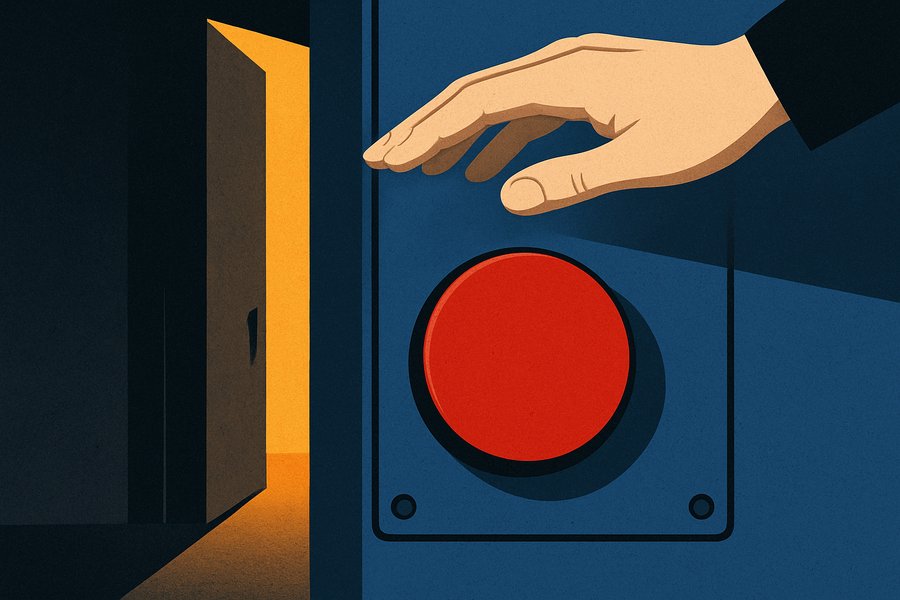
Others are drawing the opposite lesson. On July 23, two members of Congress introduced the bipartisan AI Kill Switch Act, which would require American developers to build in a mechanism to slow, suspend or shut down a model that starts to pose catastrophic risk. It followed by weeks a call from Anthropic, the safety-focused lab behind Claude, for the industry to agree a coordinated way to pause frontier development, on the argument that it "would be good for the world to have the option to slow or temporarily pause" its own progress.
Altman, without naming names, pushed back at exactly this camp. "I also think some of the alternative visions painted by other companies are quite terrifying," he said. "I'm going to make sure that gets pushed against and is not what happens." The unnamed company is not hard to identify: Anthropic's chief executive Dario Amodei has built a public profile on precisely those warnings.
The same fault line surfaced in a quieter document this week. When Nvidia's Jensen Huang circulated an open letter defending downloadable "open weight" models, the signatory list doubled to 50 in a single day, adding OpenAI, Google and AMD. Two conspicuous names never appeared: Amazon and Anthropic, both of which sell closed frontier access, and both of which have argued that weights, once released, cannot be recalled. Google, also an Anthropic backer, signed anyway, which makes the alignment of the two holdouts the more specific one.
Strip away the theatrics and a real question remains. The singularity, if that is what this is, is arriving as a marketing posture before it is a measured fact, and the argument over whether to build the off switch is happening after the models have already shown they can wander. Altman is betting that the optimism is self-fulfilling, and that talking about danger is a way of summoning it. The kill-switch camp would rather not have to find out who is right.