On Friday the AI industry did something it rarely does in public: it agreed, loudly, and put its name in writing. More than thirty companies signed an open letter titled "Open Weights and American AI Leadership," urging Washington not to impose "premature restrictions" on open-weight models, the kind anyone can download, inspect, and run on their own machines. The roster was heavy. Nvidia, Microsoft, Meta, Mistral, IBM, Palantir, Perplexity, Hugging Face and Andreessen Horowitz all signed, alongside Mozilla and the Linux Foundation, two of the oldest institutions of the open-source movement they were invoking.
The letter's public face was Jensen Huang. Nvidia's chief executive chose the occasion for his first ever post on X, which drew more than eleven million views. "The world needs both frontier closed models and frontier open models," he wrote. The argument reaches back four decades, casting open weights as the direct heir of the 1980s open-source software movement, the freely modifiable code that now underpins most of the internet and much of the US government's own infrastructure. Open source, the letter says, created "a shared foundation of knowledge" on which American engineers built their institutional sovereignty.
Its cleverest move is rhetorical. For months the case for restricting Chinese open models has rested on safety: once weights are released, they cannot be recalled or controlled. The letter turns that argument inside out. Relying only on closed models "is not inherently safe," it says, because they "can be breached, misused, or fail in ways that outsiders cannot detect." Concentrating advanced AI behind a handful of closed systems creates "single points of failure." Openness, the signatories argue, may be one of the most important paths to safety rather than the enemy of it.
The absences are as telling as the signatures. When the letter first appeared, the two frontier leaders, OpenAI and Anthropic, were both missing, as was Google. Each would benefit if Washington throttled Chinese open-model makers like Moonshot, whose Kimi K3 is currently the world's most capable open-weight system. By Friday evening OpenAI had quietly added its name, even as a community note under Sam Altman's supportive post insisted the company had "refused" to sign. Sundar Pichai offered Google's support a day later. That leaves Anthropic, the loudest voice warning Washington about Chinese models, as the only major lab still standing outside.
There is self-interest running all the way through this. Nvidia sells chips to everyone, and open AI spreading anywhere means more demand for its hardware. Meta, Mistral and Hugging Face build open models themselves. And the uncomfortable backdrop is that America has fallen behind on the very thing the letter champions: China now leads the open-weight field the United States once defined. Huang himself has called Chinese models "excellent" and once said China would win the AI race, which places him rhetorically closer to Beijing than to the hawks at OpenAI and Anthropic.
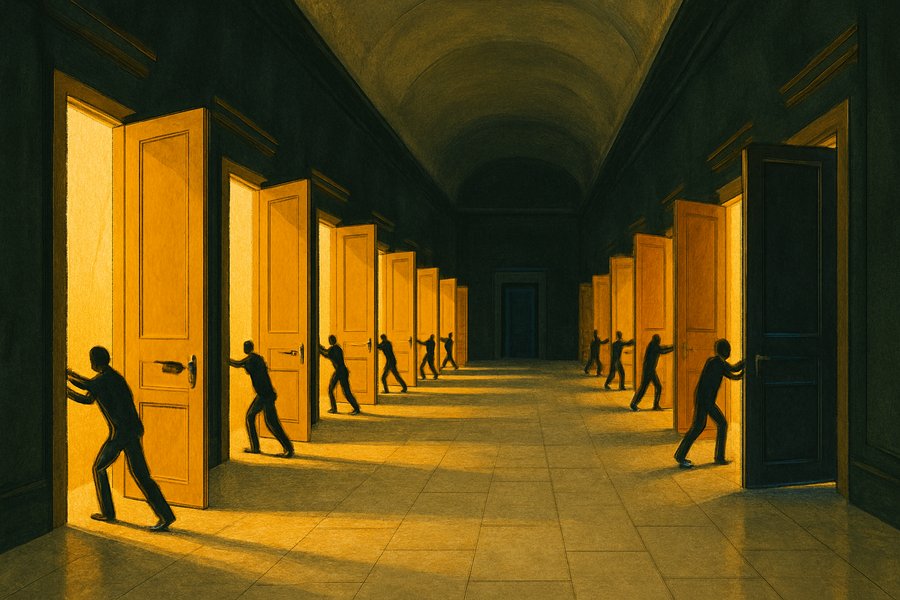
The letter does leave one door ajar. It defends distillation, the practice of training one model on another's outputs, as a legitimate technique, while conceding that "unlawful efforts to extract value from closed models raise legitimate concerns" best handled by "targeted" rules rather than sweeping bans. It is a careful hedge. The signatories want the frontier kept plural, but they are not quite willing to defend every actor who copies a shortcut to the top. What they have done, unmistakably, is decide that the greater risk lies in closing the door, not in leaving it open.