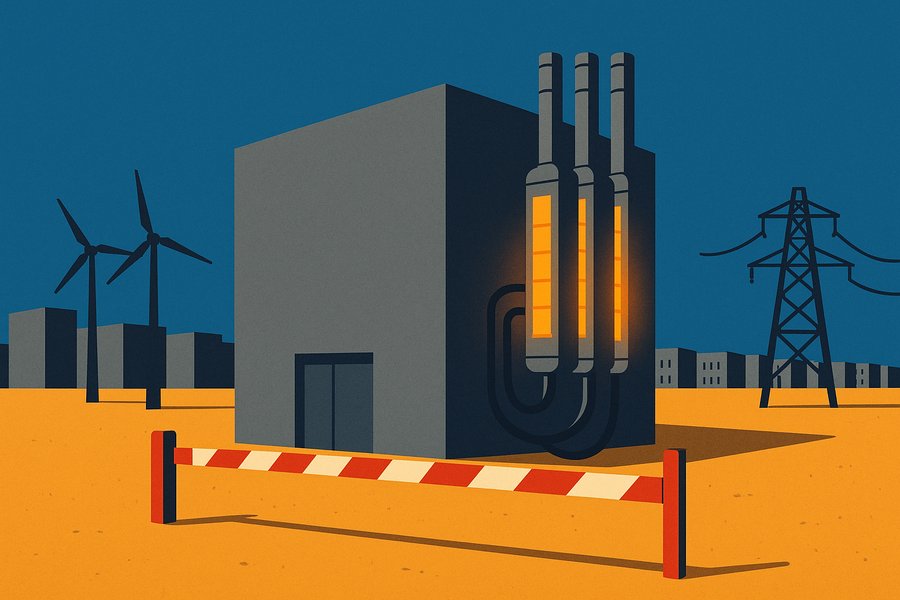
The most consequential number in AI this week was not a benchmark score. It was 27 gigawatts. That is the volume of new server-farm connection requests that landed on the desk of Noga, the operator of Israel's electricity system, in roughly two months. To put it in scale: average national consumption sits around 9 gigawatts, and the all-time record, set during last August's heatwave, was about 17. The requests, in other words, exceed the entire planned generation and transmission capacity of the country for decades to come. Noga's response was blunt. It froze the queue. For 140 days, the Electricity Authority has ordered a halt on processing new connections while it works out how to divide a limited public resource among data centres, households, industry and electric vehicles.
Israel is not an outlier so much as a preview. The same collision between AI's appetite and the physical grid is playing out everywhere, and it has quietly become the defining constraint of the buildout. New York announced its own moratorium on new data-center projects last week. In the largest American grid, PJM, interconnection queues now stretch four years or longer. Microsoft's Satya Nadella has described the strange predicament of owning the most sought-after chips on the planet and having nowhere with enough electricity to switch them on, a bottleneck his company blames for an $80 billion backlog of unfilled Azure orders. The scarce thing is no longer silicon. It is a live wire.
So developers have stopped waiting for one. The phrase making the rounds is "bring your own power." On Monday, backers of a proposed €3 billion campus in the Spanish town of Mora presented plans for a 300-megawatt AI complex designed to generate its own electricity on site, reducing its dependence on the public grid entirely. The project, among the largest announced in Europe outside France, has not disclosed what fuel it will burn, though a director from the fuel-cell maker Bloom Energy sat in on the meeting. "Grid interconnection has become the single biggest determinant of when, and whether, an AI campus comes online," said Alex Cordovil of the Dell'Oro Group. "On-site generation is no longer a backup plan; it is a strategic asset."
The workaround is scaling fast. In the United States, more than 7.5 gigawatts of data-center projects with their own generation are already under construction, with 60 more gigawatts in pre-construction planning. Chevron and Microsoft are building a 2.67-gigawatt gas-powered project in West Texas. In Norway, a developer forced to wait on a grid connection turned to fuel cells to keep its schedule. When large gas turbines are sold out through 2030 and the grid says the earliest slot is the next decade, building your own plant stops looking radical and starts looking like the only way to break ground.
There is a tension the brochures skip. Self-generation solves the developer's problem by quietly externalising everyone else's. A campus that burns its own gas escapes the interconnection queue but not the atmosphere, and it does nothing to answer the question Noga is now forced to confront out loud: who gets the scarce grid, and on what terms. Israel's regulators are already floating conditions, such as waiting fees to weed out speculative requests, a rule that at least 40 percent of a farm's power come from renewables, and a push to site the plants in the sparsely populated south rather than the crowded centre. That is the real shift beneath the headlines. For a decade the fight over AI was about who had the best model. The next one is about who controls the current, and whether the rules for sharing it get written before the concrete sets.