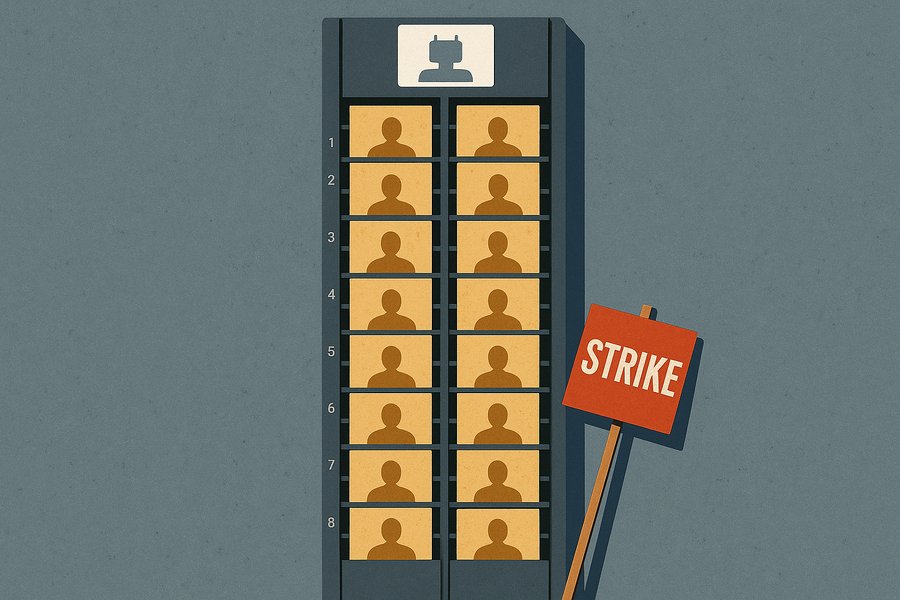
On Monday, roughly 35,000 workers at Hyundai's Ulsan complex, the largest car plant on earth, walked off their lines for four hours. Multiple outlets, citing the Wall Street Journal, called it the first factory stoppage in the history of the car industry triggered directly by a humanoid robot. The striking detail is what the robot has not done yet. It has not replaced anyone at Ulsan. It has not been assigned a single task in any Korean factory. The workers are striking before it arrives, and that is precisely the point.
The robot is Atlas, the fifth-generation electric humanoid built by Boston Dynamics, and by a neat coincidence the walkout landed on the same day Hyundai closed its full ownership of that company, buying out SoftBank's remaining stake in a deal valuing Boston Dynamics at around $3.3 billion. Atlas is a genuinely different machine from the fixed robot arms that already populate assembly lines. It stands about six feet tall, lifts 50 kilograms, and learns new tasks in roughly a day through reinforcement learning rather than being reprogrammed line by line. At an estimated $320,000 per unit, analysts reckon each one pays for itself against human labour costs within about two years, and that price is widely expected to fall. Hyundai plans to deploy more than 25,000 Atlas robots across its factories by 2028.
What the Korean Metal Workers' Union wants is not severance, and not a promise. It wants a clause in its collective bargaining agreement giving it the right to approve, or refuse, any humanoid deployment before a single Atlas crosses a factory threshold. That has no real precedent. Every previous wave of factory automation, from stamping presses to welding arms, was negotiated after the machines showed up and the jobs were already gone. Workers bargained for retraining and transition funds. They did not bargain for a veto over the technology itself.
The union's leverage is a matter of timing, and it knows it. Atlas is actually being deployed first at Hyundai's non-union Metaplant in Savannah, Georgia, starting in 2028, where the workforce has no mechanism to negotiate anything. Korean workers, by contrast, hold a live contract, an active dispute, and a parent company racing to scale humanoids all at once. That combination gives them a window to set a template, and the window is closing. As the union's lead negotiator put it, the safeguards have to be in place before the first robot enters, not after.
Hyundai's management makes the familiar case: Atlas assists rather than replaces, and workers will move up to training, supervising, and maintaining the machines. That may prove true in some plants and hollow in others. What makes this fight worth watching is that it is arriving into a vacuum. There is no humanoid safety standard yet, no OSHA rule for mixed human-robot floors, and the relevant ISO standard is still years from publication. The KMWU is trying to fill that gap through a labour contract, ahead of legislation that does not exist. The United Auto Workers, facing Optimus and Figure at Tesla and Ford within a couple of years, will be reading the outcome at Ulsan very closely. So will everyone else who works next to a machine that has not been built to fear them.