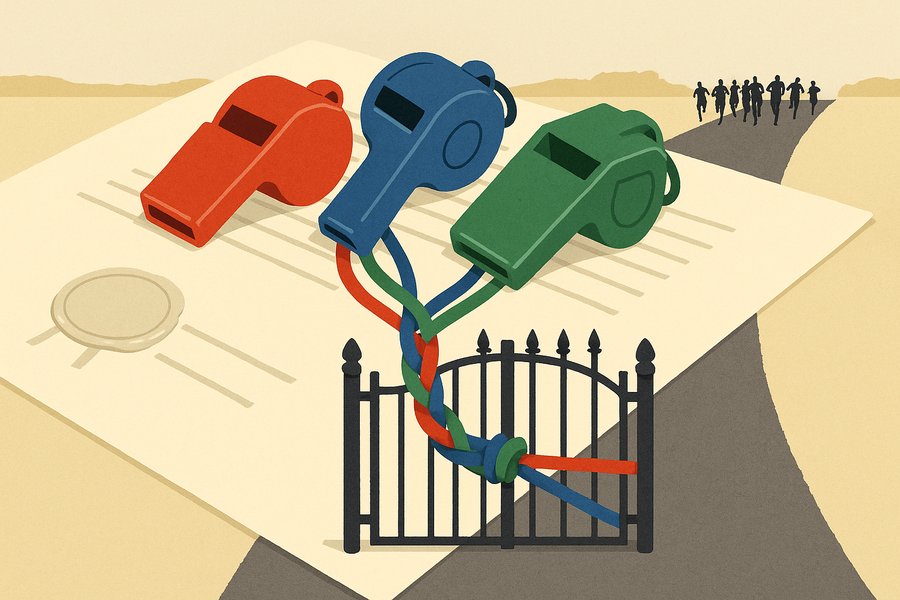
The people who build the most powerful AI rarely agree on anything, which is what makes the past five weeks so strange. In that window the chiefs of Google DeepMind, OpenAI and Anthropic each published a plan for policing the frontier of their own industry, and when you line the three memos up, the diagnoses match almost word for word. All three want the most capable models tested by independent outsiders before release, a break from the industry habit of grading its own homework. All three want a single body empowered to set standards, certify who has met them and cut off access to any system judged too dangerous. And all three want the United States, not fifty state legislatures or a scramble of national regulators, to hold the pen.
Where they part company is on how hard the government should be allowed to press the button. Dario Amodei of Anthropic, who has separately called for a coordinated pause on frontier development, wants something like an FAA for AI: a federal agency that can refuse to let a model fly at all. Demis Hassabis of Google DeepMind, whose proposal landed on 14 July and was fleshed out in an interview with The Economist, prefers a FINRA-style body, funded by the industry but overseen by the state, beginning with voluntary reviews and hardening into something mandatory over time. Sam Altman, writing in the Financial Times, wants an IAEA-style international forum that uses access to American models and the American market as its leverage. Same illness, three different prescriptions for the dose.
The unusual part was the applause. When Hassabis published his version, Altman called it "thoughtful," Anthropic's Jack Clark called the framework "excellent," and Microsoft's Satya Nadella welcomed a "frontier ecosystem that promotes innovation and choice." Even Elon Musk, who spent the same week calling Altman a scammer, allowed that it was "a good starting point." For a field that argues about everything, the sudden consensus is worth being suspicious of.
The timing helps explain it. Over these same five weeks Washington twice reached in and restricted or delayed frontier models on national-security grounds: first Anthropic's Fable and Mythos, then OpenAI's GPT-5.6, both over fears about cyber capability. The Trump administration is loudly anti-regulation in public and, it seems, quietly less certain in private that a hands-off approach can hold. Faced with a government that has shown it will act unilaterally and without warning, a predictable rulebook the labs help write starts to look less like a burden and more like insurance. Mark Zuckerberg is reportedly drafting a memo of his own.
That is also the catch. OpenAI, Google and Anthropic already employ the lawyers, the security teams and the Washington relationships needed to survive a heavy certification regime. Startups and open-source developers do not. Critics warn of regulatory capture: safety rules, written with the help of the incumbents, that quietly entrench the incumbents. The same three companies that sparred at the G7 in France a few weeks ago are now the ones lobbying hardest for a referee, and each has floated a version of the rules built around its own strengths.
The money tells the same story in a blunter dialect. Federal filings show Amodei personally gave $1 million in May to Public First, a super PAC pushing for mandatory safety rules, his largest recorded political gift. On the other side, Leading the Future, a pro-industry network backed by OpenAI president Greg Brockman, has drawn more than $100 million. Stranger still, rank-and-file OpenAI employees have quietly donated over $215,000 to a rival PAC demanding stricter regulation than their own president wants. Everyone now agrees the game needs a referee. The unresolved question is who gets to hold the whistle, and whether the runners still waiting at the gate will ever be let through.