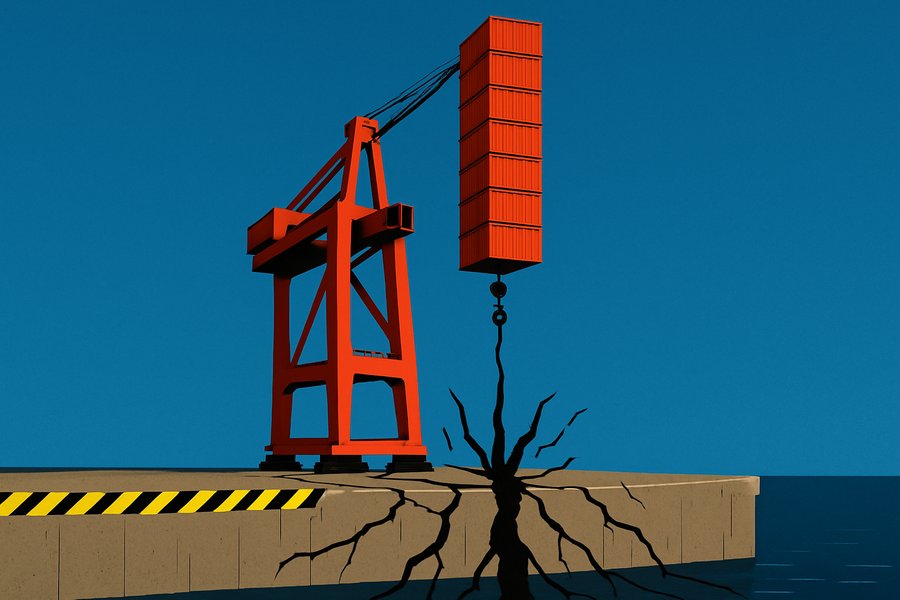
China posted two numbers in the space of 24 hours this week that appear to tell opposite stories. On Tuesday, customs data showed June exports surged 27 percent from a year earlier to a record $412 billion, the fastest monthly pace since October 2021 and far above the 18 percent economists had penciled in. On Wednesday, the statistics bureau reported that second-quarter GDP grew just 4.3 percent, missing forecasts and slipping below Beijing's own 4.5 to 5 percent target range for the first time this year. The temptation is to treat these as a contradiction. They are better read as two symptoms of one imbalance.
Artificial intelligence sits at the center of the export figure. Wang Jun, a vice minister at the customs administration, told reporters that trade in electronic components and computing hardware jumped nearly 57 percent in the first half. The headline that traveled furthest was integrated circuits: export value rose 96 percent to $177 billion. That number deserves a caveat the headline rarely carries. At roughly a dollar per chip across 179 billion units, the mix is dominated by commodity memory, DRAM and NAND flash, whose prices have been driven up by AI data center demand, plus chips shipped into China for packaging and test before re-export. It reflects a price cycle, not a sudden leap to advanced-chip parity with Taiwan or South Korea.
Julian Evans-Pritchard of Capital Economics put it plainly: the surge "predominantly reflects the recent surge in semiconductor prices on the back of the AI boom." Cars told a parallel story, with monthly shipments topping one million for the first time as the Iran conflict pushed energy-importing markets toward electric vehicles. Foreign demand, in other words, is doing the heavy lifting.
The problem is what sits beneath it. Property investment fell 18 percent in the first half, fixed-asset investment dropped 5.7 percent, and retail sales barely clawed back to a 1 percent gain in June after their first decline since the pandemic era in May. "No domestic demand, all about exports," Alicia Garcia-Herrero of Natixis told CNBC. "It's really quite unsustainable, to be frank." A country with healthy internal demand does not run a $125 billion trade surplus in a single month; it spends more of that output at home.
That surplus is also arriving at an awkward moment. Some of June's strength was manufactured urgency: exporters front-loading shipments to beat a US tariff deadline. Section 122, the flat 10 percent surcharge imposed after the Supreme Court struck down the earlier tariff regime, expires by statute on 24 July and cannot be extended by the president alone. The likely replacement, Section 301 duties of 10 to 12.5 percent, carries no expiry and no rate cap. July's trade data will be the first clean read of what structural AI demand looks like once the front-running fades.
So the export boom and the growth miss are not in tension. The record surplus is a measure of how much China now leans on the outside world, and how thin the domestic cushion has become if AI capital spending abroad ever cools or the tariff wall rises. Analysts expect the late-July Politburo meeting to lean toward targeted measures rather than a large stimulus. The direction matters beyond China: support tilted toward semiconductors would inflate the very export numbers stoking friction in Washington and Brussels, while support for households would start to rebalance an economy currently riding on one very strong, very exposed engine.