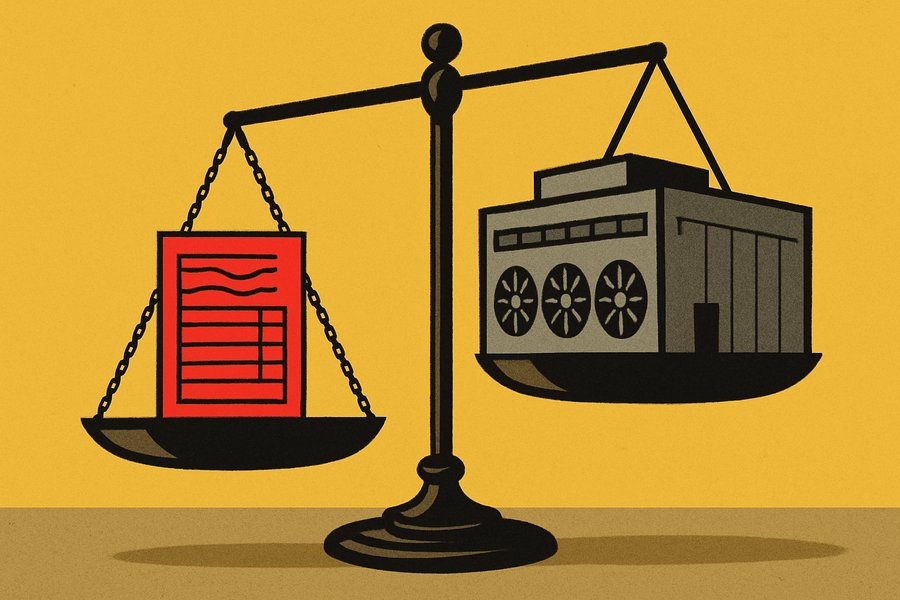
For three years the AI buildout has been described in the language of national ambition: capacity, competitiveness, the race. This week it started being described in the language of the household budget. Governor Kathy Hochul announced a one-year pause on new large-scale data center construction in New York, making it the first US state to formally stop the build. The stated reasons were not abstract. They were utility bills, water, and grid strain.
The moratorium applies to facilities drawing 50 megawatts or more. During the pause, the state's Department of Environmental Conservation will withhold new discretionary permits for projects that have not already cleared approval, while regulators run an environmental review covering electricity, water, land use and community impact. Hochul also signalled she will seek to repeal some sales tax exemptions that data centers currently enjoy, which is the part the industry will notice most. A pause is temporary. Withdrawing a subsidy is a change of mind.
New York is the first state to act, but it is not an outlier. At least 14 states are weighing legislation to slow or restrict data center construction, and a number of cities have already passed moratoriums or outright bans. What changed is not the technology. It is that the cost has become visible to people who never opted in. In Virginia, whose data center corridor now accounts for roughly 40 percent of state electricity consumption, one Manassas homeowner reported a January bill of $281, about triple his normal charge. In the PJM grid region, capacity market prices rose 174 percent for the 2025-26 delivery year, and Baltimore households saw average monthly bills jump by more than $17.
The mechanism behind this is duller than the politics, and more important. Under current interconnection rules, grid upgrade costs are largely socialised across all customers. FirstEnergy told federal regulators earlier this year that existing transmission rules will not let data center operators cover their own infrastructure costs even when they want to. That is the detail that turns a technology story into a political one: the households paying are not paying because anyone decided they should, but because the rulebook has no other way of allocating the cost.
The White House response so far has been voluntary. An expanded "Ratepayer Protection Pledge" summit is expected within weeks, widening the original March gathering of seven hyperscalers to include the utilities that supply them and the operators who build on their behalf. Whether a pledge can fix a tariff structure is the open question, and the honest answer is that it probably cannot. Pledges do not amend cost allocation rules; regulators do.
Meanwhile the macroeconomic version of the same story is arriving. Data center investment is likely to top $700 billion this year, with Alphabet, Amazon, Meta and Microsoft alone expected to spend around $720 billion. That demand has drained the memory chip supply: JPMorgan Chase economists estimate some memory chip costs will have risen as much as 400 percent between 2024 and the end of this year. Apple has already raised laptop and iPad prices by 15 to 25 percent, saying it had "never seen a component price increase this much, this quickly." Microsoft is putting $100 on the Xbox. Economists now expect AI spending to keep pushing inflation above where the Federal Reserve would like it, which could mean higher interest rates later this year.
There is a tension the industry has not resolved. The buildout is justified by future productivity gains that are, so far, largely promissory. The costs are present tense, itemised, and arriving monthly. Renewable advocates are pushing for data centers to be held to clean energy benchmarks, and legislation on Hochul's desk would require large facilities to hit renewable targets from 2030 and draw 90 percent of their power from renewables by 2040. But wind and solar cannot be built at the speed the hyperscalers want power, which is why the AI boom has instead triggered the largest natural gas plant construction wave in decades and kept coal plants running past their retirement dates.
New York's pause lasts a year. What it really buys is time to answer a question the buildout raced past: who pays. Until the tariff rules change, the answer is everyone, whether or not they have ever typed a prompt.