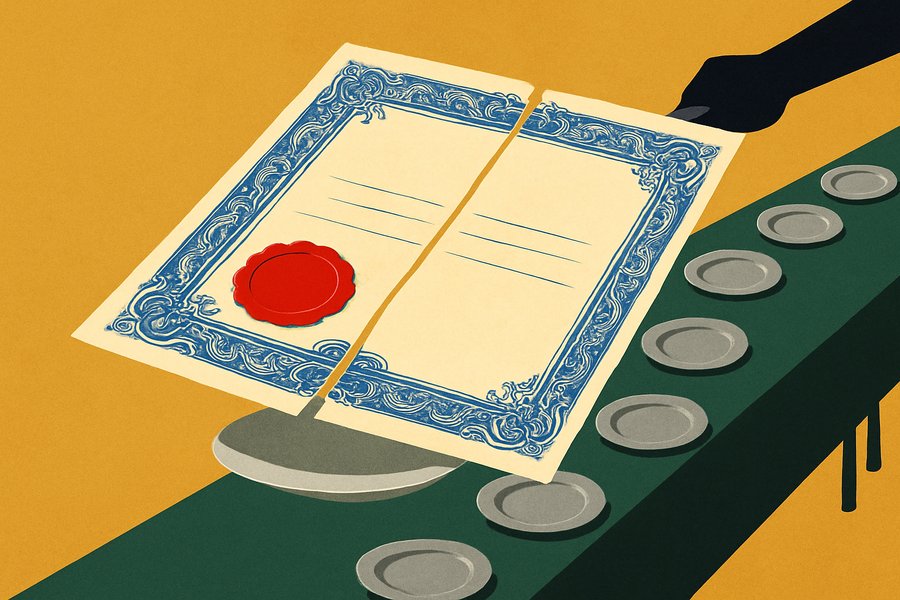
A year ago, the idea that the US government should seize half the equity of its largest AI companies was a fringe position. This week it is a majority one. A Verasight survey of 1,690 American adults, conducted in June and reported by CNBC, found that 69% support forcing AI firms to transfer 50% of their stock into a public sovereign wealth fund. That is the exact policy in Senator Bernie Sanders's American AI Sovereign Wealth Fund Act, introduced last month and pitched as a roughly $7 trillion pool. Sanders frames it as a debt being collected: the public paid for the research and the infrastructure, so the public should share the returns.
What makes this week different is not the poll. It is who else spoke up.
On Monday, more than 200 economists, researchers and executives signed an open letter, four sentences long, titled "We Must Act Now." Organised by Stanford's Digital Economy Lab, it warns that AI "may become radically more powerful over the next 10 years," driving a transformation "larger than the Industrial Revolution, but unfolding over a vastly shorter time frame," with "large-scale job displacement" among the risks. Sixteen Nobel laureates signed, including Joseph Stiglitz, Daron Acemoglu and Simon Johnson. So did Eric Schmidt and Reid Hoffman. And so, notably, did people who build the thing: Google's AI lead Jeff Dean, Anthropic cofounder Jack Clark, OpenAI finance chief Sarah Friar, and the chief economists of both OpenAI and Anthropic.
That last detail is the story. The usual shape of a technology panic is outsiders warning and insiders reassuring. Here the labs have co-signed the warning. Yoshua Bengio, another signatory, put the political conclusion plainly: "We must be intentional and make collective, democratic choices, rather than letting market forces play out and risking leaving most citizens behind."
Outside the letter, the mood is less procedural. On Saturday, around 200 people marched through San Francisco from OpenAI to Anthropic to Google DeepMind, carrying placards reading "stop slop," "it's not too late to regulate," and "in a race off a cliff, no one wins." The rally, organised by the group Stop the AI Race under former AI researcher Michaël Trazzi, called on the labs to jointly suspend new model training; a hunger strike ran outside Anthropic's Howard Street office. The marchers were not all outsiders either. Aleesa Carbo, a Johns Hopkins student on an AI safety fellowship, told reporters she is "not fundamentally opposed to AI" but doubts the companies are developing it responsibly. "Protests can only do so much," she said, hoping instead to push people toward their senators.
So the alarm is broad, the industry is inside the tent, and the public has already chosen a remedy. There is one uncomfortable gap in the middle: the evidence.
Despite the volume of AI layoff headlines, there is still little proof of widespread job losses directly caused by the technology. Recent work from Harvard Business School, INSEAD and the University of Toronto suggests AI is changing hiring before it changes employment, with venture-backed startups taking on fewer entry-level workers and more experienced ones. IMF researchers find adoption still concentrated among a minority of workers, too narrow to have produced a broad labour-market shock. The most cited forecast, from Goldman Sachs economist Joseph Briggs, holds that more than 9% of the labour force, around 15 million workers, could lose jobs across a decade-long transition; the same report expects those losses to prove temporary as new jobs appear.
What people are actually reacting to may be simpler and harder to argue with: the juxtaposition. Tech accounted for close to a third of US layoffs in the first half of 2026, and the same firms doing the cutting are raising their AI capital spending and posting higher profits. You do not need a causal model to find that galling. As Verasight's chief executive Benjamin Leff put it, the public sees these funds "as a tool to distribute the gains from the AI industry back to broader society."
The objections are real. Critics call a forced 50% transfer a seizure of private property dressed up as a dividend, one that would chill investment and push AI development offshore. Poll wording does a lot of work, and support for a policy is not the same as support for its consequences. Even sympathetic analysts note the tension inside any sovereign fund between maximising returns for citizens and governing the industry it now owns.
But the political fact stands, and it is unusual. Ordinarily a public demands compensation after the damage is demonstrated. This time the demand for a share of the upside has arrived first, endorsed by seven in ten Americans, while the economists are still writing letters asking for someone to study the problem. Sanders has a bill. Senator Ed Markey's AI Accountability Agenda lists "sharing the AI wealth" among six priorities. The industry's own chief economists have now signed a document saying the guardrails do not exist yet. The open question is no longer whether the AI economy will be governed by something other than market forces. It is who writes that something, and how angry they are by the time they do.