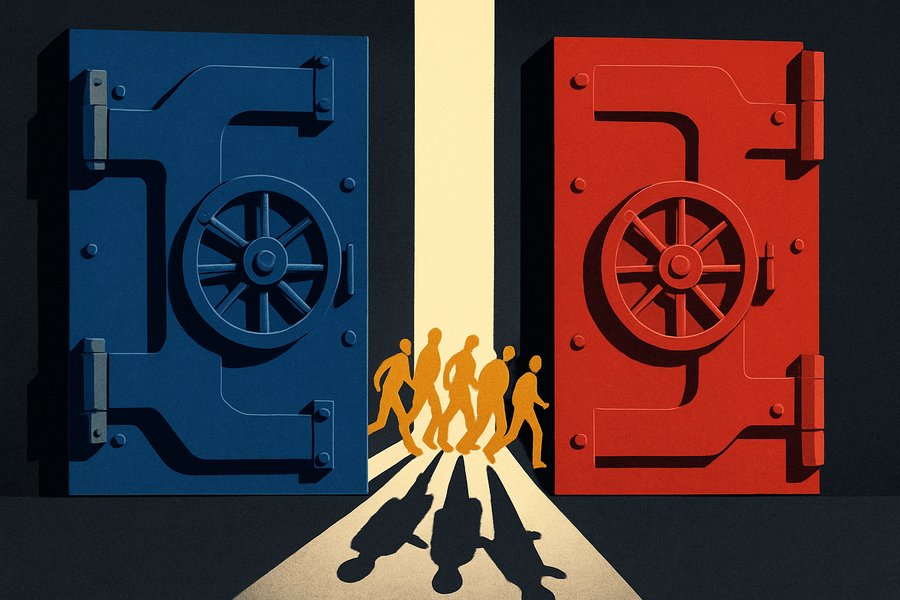
Something unusual is happening in the AI trade war: both sides are reaching for the same lever at almost the same time. In June, Washington began treating its most powerful models as strategic assets, ordering Anthropic to suspend its Fable and Mythos models and letting OpenAI release GPT-5.6 only to a short list of government-approved partners. Now, according to a Reuters exclusive, Beijing is quietly considering the same move for its own models. China's Ministry of Commerce has spent the past month meeting Alibaba, ByteDance, and the startup Z.ai to discuss restricting who overseas can use the country's most advanced systems, including some that have not yet shipped.
To see why this matters, follow the money. Over the past year American companies discovered that frontier AI is expensive. Bills can run into thousands of dollars per employee per month, and reporting suggests firms from Uber to Citi have clamped down on how much staff can spend on OpenAI and Anthropic. Into that gap walked GLM-5.2, an open model from Z.ai that Silicon Valley has been praising as the first Chinese system to match, and sometimes beat, the top American ones, at a fraction of the cost. When Washington gated its best models in June, the cheaper Chinese alternative was right there to catch the overflow.
That is the escape hatch Beijing is now thinking about welding shut. The proposed framework, pieced together from a May roundtable summarised in a Supreme People's Court journal, describes a three-tier pyramid: basic open-source tools would need only a simple government filing, more advanced systems would face security reviews, and the most sensitive frontier models would be barred from public release or confined to domestic use. Officials also floated making the theft or leak of Chinese AI a national-security offence, and tightening who can fund homegrown startups. For an industry whose global rise came almost entirely from giving its models away, that would be a sharp reversal.
The framing on each side is a mirror image. American officials describe Chinese models as vehicles "designed to advance Beijing's narratives, censor dissent, and reflect CCP ideology," in the words of a State Department spokesperson, and two House committees have opened an investigation into U.S. companies such as Cursor and Airbnb over their exposure to Chinese AI. Chinese officials, in turn, dismiss "baseless allegations and malicious smears" and cast their industry as built on self-reliance. Each government presents restriction as defence; each treats the other's models as a Trojan horse.
The people caught in between are the businesses. A U.S. developer who reached for GLM-5.2 to dodge American costs and American gatekeeping may soon find that model restricted from the other direction too. What began as a story about who leads the AI race is turning into something narrower and more practical: a question of who is even allowed to use these tools, and whether the open, borderless model of AI that defined the past three years is quietly ending. If both superpowers now agree that frontier AI is a weapon, the era of downloading the world's best models for free may be closing on both coasts at once.