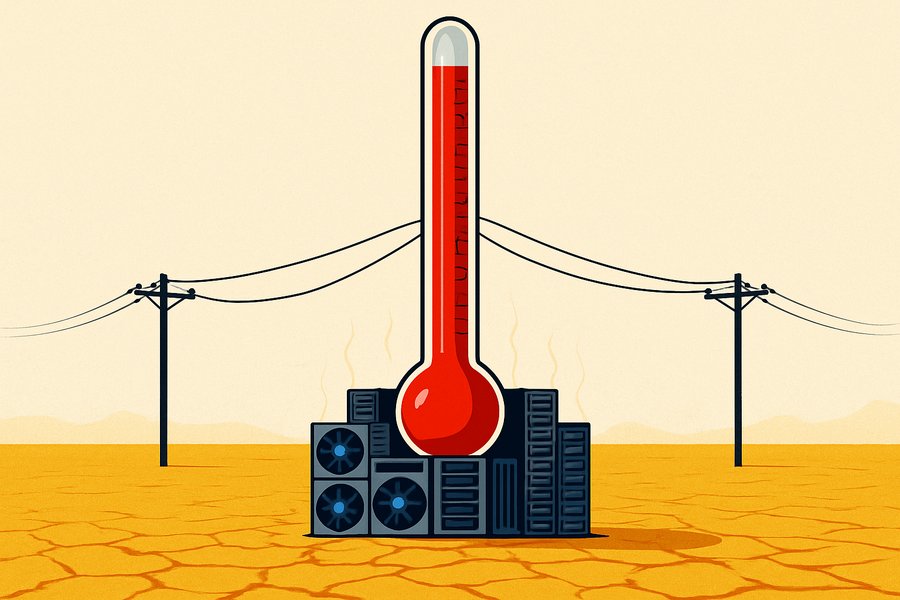
This week a dangerous stretch of heat is rolling across the central and eastern United States, peaking from Tuesday to Thursday and lingering into the Fourth of July weekend. Temperatures from Boston to Washington are forecast to top 38 degrees Celsius, with the heat index climbing toward 46. The country's largest grid operator, PJM Interconnection, expects record summer demand of 166.3 gigawatts on Thursday evening, eclipsing a peak set two decades ago. It is, on its own, an ordinary American summer emergency. What makes it a story about artificial intelligence is what has been quietly plugged into the same wires.
The trouble is one of timing. Cooling already accounts for roughly 40 percent of a data centre's energy use in normal weather, and that share climbs sharply in a heat wave, exactly when household air conditioners are also straining the grid. As Mishal Thadani of the grid-modelling firm Rhizome put it to CNBC, "Data centers need the most energy exactly when the grid has the least available to give." Add facilities that each draw as much power as a hundred thousand homes, he noted, and the heat and the load hit the same cables at the same moment. In May, the Italian city of Turin saw repeated blackouts when underground cables overheated. The fear is that frontier markets now hosting data centres have far less margin for the same shock.
Those frontier markets are precisely where the build-out is heading. The insurer Zurich reports that severe weather is now the leading cause of loss in its US data centre construction portfolio, driving about a third of claims, and that 64 percent of capacity under construction sits outside established hubs such as Northern Virginia, in places like West Texas, Tennessee and Ohio that are more exposed to tornadoes, hail and high winds. A study by the analytics firm First Street found that 79 percent of global data centre capacity faces elevated climate hazards. The industry that promises to model the future is building in spots where the weather is getting harder to predict.
It would be comforting to think engineering will quietly absorb all this. Cooling is genuinely getting better: Nvidia's newest servers can run their coolant at 45 degrees Celsius, and even a one-degree rise in chiller temperature cuts cooling energy by about 4 percent. The catch is the oldest trap in energy economics. As Tech Times laid out, the Jevons paradox, first described for coal in 1865, means cheaper and more efficient AI simply invites more of it. US data centre electricity use still climbed 17 percent in 2025 despite record per-query efficiency gains, because inference now runs continuously and scales with every new user. Efficiency lowers the cost per task; it does not lower the total when demand keeps exploding.
And the cost is no longer abstract. Retail residential electricity prices rose an average of 42 percent across the US between 2021 and 2026, with the steepest jumps in data-centre-dense areas: 94 percent in Washington, DC, and 74 percent in Maryland. In Virginia, where data centres consume nearly 40 percent of the state's electricity, typical bills have already added 11 to 13 dollars a month. Some in the industry want to sidestep the grid entirely. Venture capitalist Vinod Khosla argues that with 2,600 gigawatts of projects waiting in interconnection queues for a grid less than half that size, the answer is on-site generation that does not wait for a substation upgrade scheduled for 2029. The heat wave will pass by the weekend. The structural question it exposes, whether the grid can carry what AI is asking of it, will not.